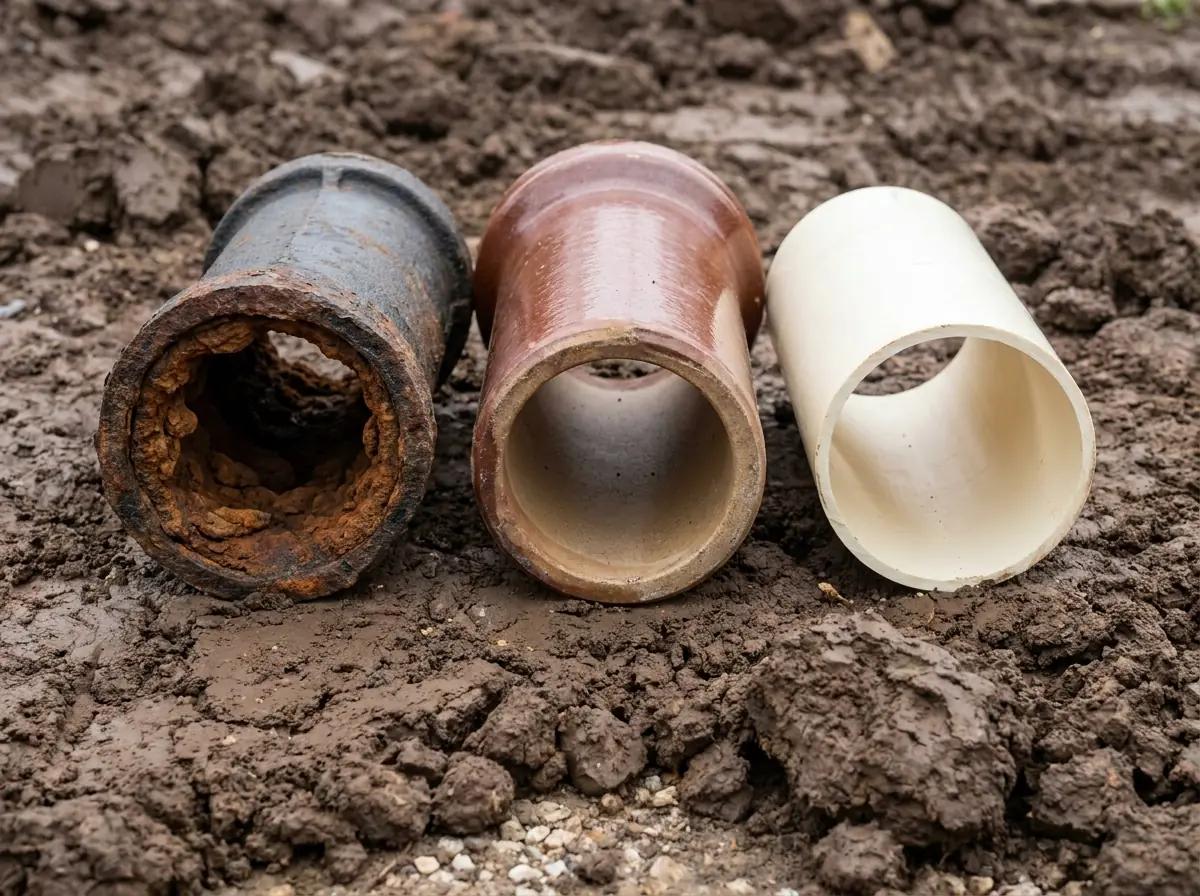
Cast iron vs clay vs PVC: what your sewer line is made of, and why it matters
People ask which of these is best. That is the wrong question, because you are not choosing — you already have one, it was chosen for you decades ago by whoever built the house, and the only useful question is what having it means.
So: three materials, three failure modes that have almost nothing in common, and three different conversations about repair.
Vitrified clay
Commonly found in homes built before roughly the 1960s, and in some areas later than that. That is a trade generalisation about what turns up in the ground, not a municipal record, and it is deliberately loose — the camera settles what any specific house has.
Fired clay pipe laid in short lengths, commonly two to four feet, with a bell-and-spigot joint between every one of them.
How it fails:
It fails at the joints, not in the middle of the pipe. Every joint is a seam a root can find, and a mature boulevard tree has had decades to find all of them. Joints also offset as the ground moves, leaving a lip that catches everything passing over it.
What the camera shows:
Root masses entering at regular intervals, matching the joint spacing. Offset joints showing a step in the pipe wall. Often a long run of sound pipe between two bad joints.
Service life:
often still structurally sound at a hundred years, provided the joints have held — age alone is not a reason to replace clay
That clause matters more than anything else in this section. The clay itself does not corrode, does not wear out and does not care how old it is. A replacement quoted off the age of the house is a quote against the calendar rather than against the pipe.
What it means for the repair:
Clay is the best trenchless host material there is: it is round, it holds its shape, and it breaks cleanly. It takes a liner well and it bursts predictably, so the camera decides which is cheaper rather than which is possible.
Clay is the easy case, oddly enough. Both full-length methods are on the table, and a single bad joint in an otherwise sound run is a spot repair rather than a replacement. The long version is here.
Cast iron
Common in mid-century construction, and still found in buildings of that period today. Typically the drain inside and under the building, and sometimes out to the property line.
Heavy iron pipe. Genuinely strong. The problem is not strength.
How it fails:
It corrodes from the inside out. Scale builds on the pipe wall and narrows the bore until a line that was four inches is effectively passing two, and eventually the bottom of the pipe — where the flow sits — corrodes through entirely while the crown still looks fine.
What the camera shows:
A rough, tuberculated interior that snags the camera. Channelling along the invert where the bottom has worn away. The pipe can look intact from above and be gone underneath.
That last sentence is the one that catches people out, and it is a real trap in this trade. A cast iron line can look acceptable to a camera pointed down the middle of it while the bottom third has effectively ceased to exist. An operator who is not specifically looking for channelling along the invert can miss it, and a homeowner watching the screen certainly will.
Service life:
commonly quoted at fifty to a hundred years, but corrosion rate depends heavily on what has been running through it
What it means for the repair:
Lining works only if enough sound wall remains to carry the liner while it cures, and heavy channelling can mean there is not. Descaling first is often required, and sometimes descaling is what reveals the pipe is past lining.
That is the cast iron sequence in one sentence, and it is worth knowing before anybody quotes you. The pipe has to be cleaned before it can be assessed properly, the cleaning is real work, and the cleaning can change the answer. A contractor who commits to a lining scope on cast iron before descaling is committing to something they cannot yet see.
Bursting cast iron is the more predictable route where the line is past lining.
PVC
Common from roughly the 1970s and 1980s onward, and the default in newer construction. Rigid plastic in long lengths, smooth bore, very few joints, chemically inert.
Its close relative ABS — the black plastic used widely in Canadian construction from roughly the 1970s onward — behaves much the same way for the purposes of this decision.
How it fails:
Same story as ABS — the pipe outlives the problem. Bellies from poor bedding, crushing from heavy equipment over a shallow run, and root intrusion at a gasketed joint that was not seated properly.
What the camera shows:
Long clean runs. A defect in PVC is usually one identifiable event at one location, not a line-wide condition.
Service life:
expected to outlast most of the houses it was installed under, absent physical damage
What it means for the repair:
Where the camera shows PVC and a single blockage, the answer is usually a cleaning rather than a replacement. Plastic of this age has not run out of service life, and what has gone wrong is almost always one identifiable event rather than the pipe giving up.
This is the section that should save some readers a great deal of money. If you live in a community built from the 1980s onward, your line is very likely plastic, and a backup out there is a blockage far more often than it is a failure. That is a drain cleaning job.
The one real exception is a belly — a low spot where the bedding settled and water now stands. The pipe is sound, the geometry is not, and it will block in the same place indefinitely. A liner cannot help, because a liner reproduces the geometry it is given. That is a re-lay: bursting, or a dig.
The three side by side
| Clay | Cast iron | PVC | |
|---|---|---|---|
| Where it goes wrong | The joints | The bottom of the pipe | One specific event |
| Pattern | Repeating, along the whole run | Progressive, along the whole run | Local |
| Camera signature | Roots at regular intervals, offsets | Rough wall, channelling at the invert | Long clean runs, one defect |
| Lining | Good host | Conditional — depends what is left after descaling | Conditional — and pointless on a sound line |
| Bursting | Predictable | Works | Works, rarely needed |
| The usual mistake | Replacing it because the house is old | Assessing it before descaling | Replacing it when it wants cleaning |
What all three have in common
Only one thing, and it is the thing worth taking away.
Nobody can tell you which of these you have, or what state it is in, without looking down it. Not from the age of the house, which is a decent guess and no more. Not from what the neighbour had done. Not from a snake hitting something forty feet out.
The material rules out more options than any other single fact. Clay opens both full-length methods. Cast iron opens one of them conditionally and only after cleaning. PVC usually rules out repair altogether because there is nothing wrong with the pipe.
And one material closes the question entirely: Orangeburg cannot be lined at all.
We camera the line before we quote it. On this trade that is not a service feature, it is the only way the recommendation means anything.
What the camera shows · How long a sewer line lasts · Book a survey
Want the line looked at?
Nothing here gets quoted off a description. The camera goes down first, you watch the screen, and you keep the footage — including on the jobs where the answer turns out to be that nothing needs replacing.