Water Line Repair
A leak in one place with sound pipe either side of it is a repair, not a replacement. Finding out which one you have is the first job.
Inside this section
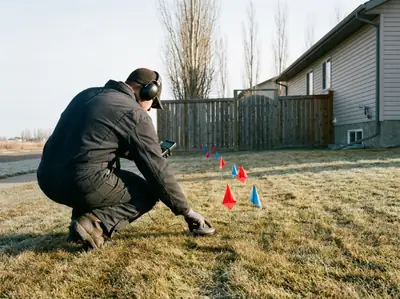
A sewer problem announces itself. Sewage on a basement floor is not subtle and nobody has to be persuaded that something is wrong. A water service does the opposite: it is under pressure every hour of every day, so when it opens up it pushes water into the ground continuously — and the ground very often takes it without complaint. Most people come to this page with a suspicion rather than a flood. A utility bill that climbed with no change in how the house is used. A patch of lawn that stays green through a dry stretch. A faint running sound in a quiet house at night with every tap closed.
The other half of the arrivals are not suspicious at all, because their service let go rather than wept. That is a different day: water surfacing in the yard, a soft spot in a driveway, pressure gone. It is worth saying plainly that both of those are the same underlying question. A leak is a leak. What separates a fifteen-minute repair from a full replacement is not how dramatic it looked when it started — it is what the pipe looks like at the point we open it.
That is the whole decision, and it belongs at the top of the page rather than at the bottom of a quote. The material spine of this site records copper as good for commonly decades of service, with soil conditions along the run mattering more than age — soil along the run, not the calendar, is what decides. So: a single failure with sound metal either side of it is a repair, and repairing it is both the correct answer and the cheaper one. A service that has started to go in more than one place is not repairable in any meaningful sense. Each fix is a deposit on the next one, and two repairs on the same run — each with its own excavation and its own reinstatement — will normally cost more than replacing the line once. We will tell you which of those the exposure shows, including on the days when the answer is the small job.
How water line repair runs, step by step
-
Step 1
Confirm there is a leak
A meter test with everything shut off says whether water is moving when nothing is using it. That is the question before any digging.
-
Step 2
Pinpoint it
Acoustic detection and correlation narrow a leak to a position, so what gets opened is one hole rather than the length of the run.
-
Step 3
Expose and assess
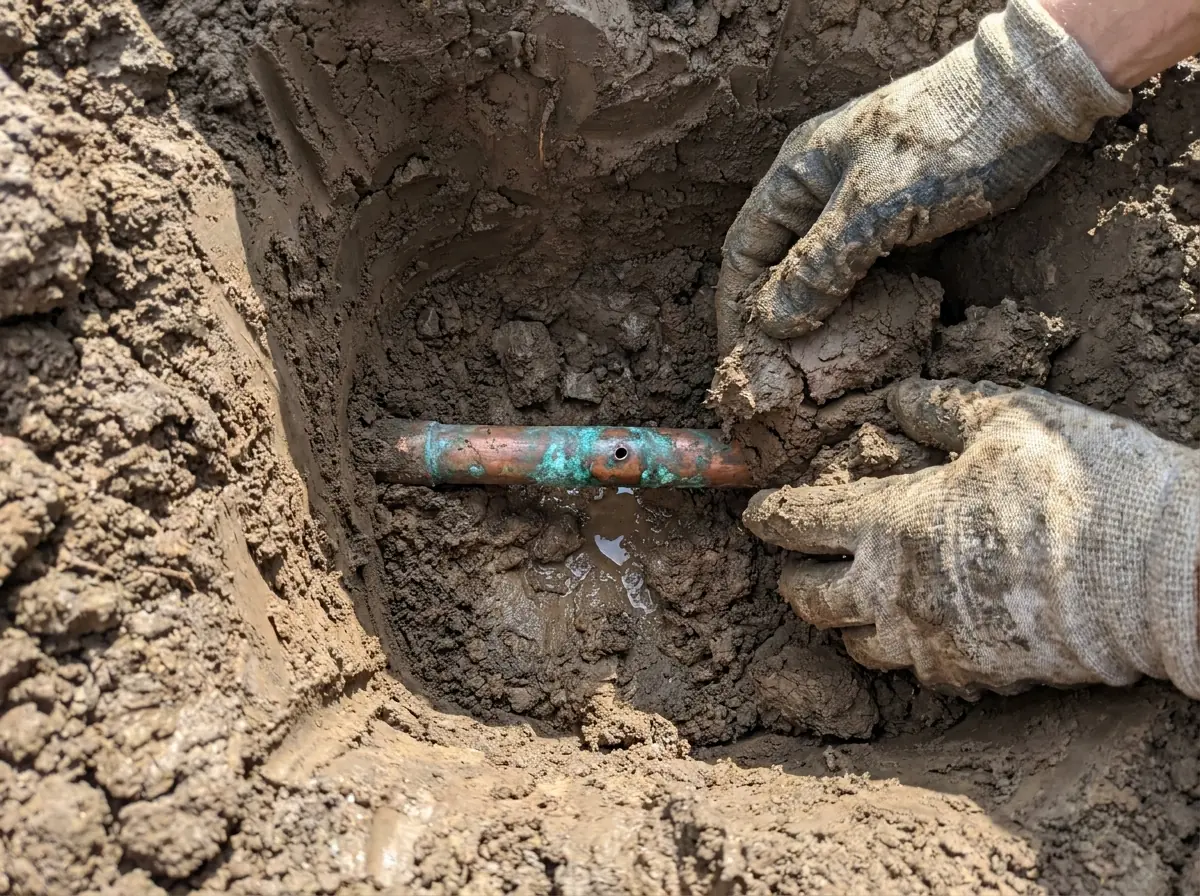
The pipe is uncovered at the leak and the condition of the metal either side of it is what decides repair against replacement.
-
Step 4
Repair or recommend replacement
A single failure in otherwise sound pipe gets repaired. A service that is pinholing along its length gets an honest recommendation instead.
-
Step 5
Test and reinstate
Pressure tested before anything is backfilled, and the ground put back.
What the day actually looks like
Almost all of the effort on a repair goes into not digging. The sequence is meter test, then acoustic work along the run, then correlation to fix a position and a depth, and only then does anything get opened. Done properly that means one hole in a known place instead of a trench chasing a guess, and the difference between those two outcomes is most of what the job costs. The page on leak detection covers how the locating itself works and what defeats it.
Once the pipe is exposed the visible work is short and the assessment is the part that matters. The service is isolated, the leak is cleaned back, and the condition of the metal on both sides of the failure is examined — pitting, wall thickness, how the surface looks where it has been in contact with the soil. On copper that reading is usually clear. On galvanized steel it is clearer still and rarely good, and our material notes are blunt about why: Replaced rather than repaired. A galvanized service that has lost its bore cannot be restored — cleaning it removes what is left of the protective layer. Then the repair goes in, the line is pressure tested before anything is covered, and the ground is put back. Reinstatement is not a footnote: the open-cut entry in our method notes records that it takes out whatever is above the line — lawn, driveway, patio, mature tree roots — and reinstatement is often the largest part of the cost. That holds for one hole as much as for a trench, and it is why the locating work earns its keep.
What decides the scope
What a repair costs is driven less by the pipe than by what is over the leak. A failure in open lawn is a small hole and a morning. The same failure under a driveway, a walk, a retaining wall or a mature tree is the same repair with a reinstatement job attached to it, and the reinstatement is frequently the larger half. Depth is the other multiplier: a shallow leak is a hand-dig, a deep one is a shored excavation, and the difference is not proportional.
Two things can change the job before it starts. Whether the service can actually be isolated at the shutoff by the property line — a valve that has not been turned in decades does not always cooperate — and which section of the run between the main and the house is whose responsibility. That second question is genuinely load-bearing here, because a leak a few metres either way can land on a different side of it. Confirm with the City who owns the section that failed. Anyone who tells you the answer without checking is guessing on your behalf.
What people get wrong about this
Shutting the water off inside does not stop it
The valve where the service enters the house is downstream of the leak, so closing it protects the plumbing and does nothing at all about water still running into the ground outside. A leak between the connection and the building is stopped at the shutoff by the property line, not in the basement. This is the single most useful thing to know before anyone arrives.
Where the water shows is not where the leak is
Water under pressure follows whatever path is easiest — a service trench, a bedding layer, a footing drain, the underside of a slab — and surfaces where that path lets it. Digging at the wet spot is how a one-hole repair becomes four holes. It is also why the locating work happens before the shovel, not after the first miss.
A clamp on bad pipe is not a repair
A mechanical repair needs sound metal to seal against. Clamping a section that is already pitted through its wall produces a fix that holds until the next weak spot lets go, usually close by and usually soon. If the exposure shows the metal is finished, the honest answer is the bigger job and it should be said out loud at the hole.
Two repairs is the signal, not bad luck
One failure can be a stone, a strike or a bad stretch of soil. A second failure on the same run, in the same decade, is the line reporting its condition. At that point the arithmetic has usually already turned: the second repair plus its excavation and reinstatement approaches or exceeds a single pull-through replacement that ends the problem, and that comparison is worth doing before authorising the second fix rather than after the third.
When this is the wrong answer
If the meter does not move with every tap, toilet and appliance shut off, the loss is not on the buried service and a repair here fixes nothing — start with leak detection and rule the house out first, because a running toilet and a failing service look identical on a bill. If water is appearing in the basement rather than the yard, that is more often a drainage or a sanitary question than a supply one. And if the exposure shows a service that is failing along its length rather than in one place, we will recommend replacement instead and say why at the hole, before the repair goes in. Being told at the second leak that the first repair was money spent on the wrong job is a bad way to find that out.
Questions about water line repair
The ones that come up on this work specifically. The general questions are answered on the FAQ page.
Should I repair this leak or replace the whole line?
How do you find a leak with nothing showing at the surface?
What if the leak turns out not to be on my section?
People also ask
Answered in full, once, on the page each one belongs to — rather than repeated on every page of this site.
Where we work
The same work, and a different likely answer, depending on when the ground under the property was built out.
Calgary and its quadrants
Round-ups of the range of development eras in each quarter of the city, and therefore of what is most likely in the ground.
Outside Calgary
Separate municipalities, each with its own authority having jurisdiction and a mostly newer buried stock.
We camera the line before we quote it
No method gets named on the phone. Tell us what the line is doing and how old the house is, and the next step is footage you keep.