Sewer and water line repair in Southwest Calgary
Trenchless sewer and water line repair and replacement across southwest Calgary, including the oldest and most heavily treed streets in the city.
What is in the ground here
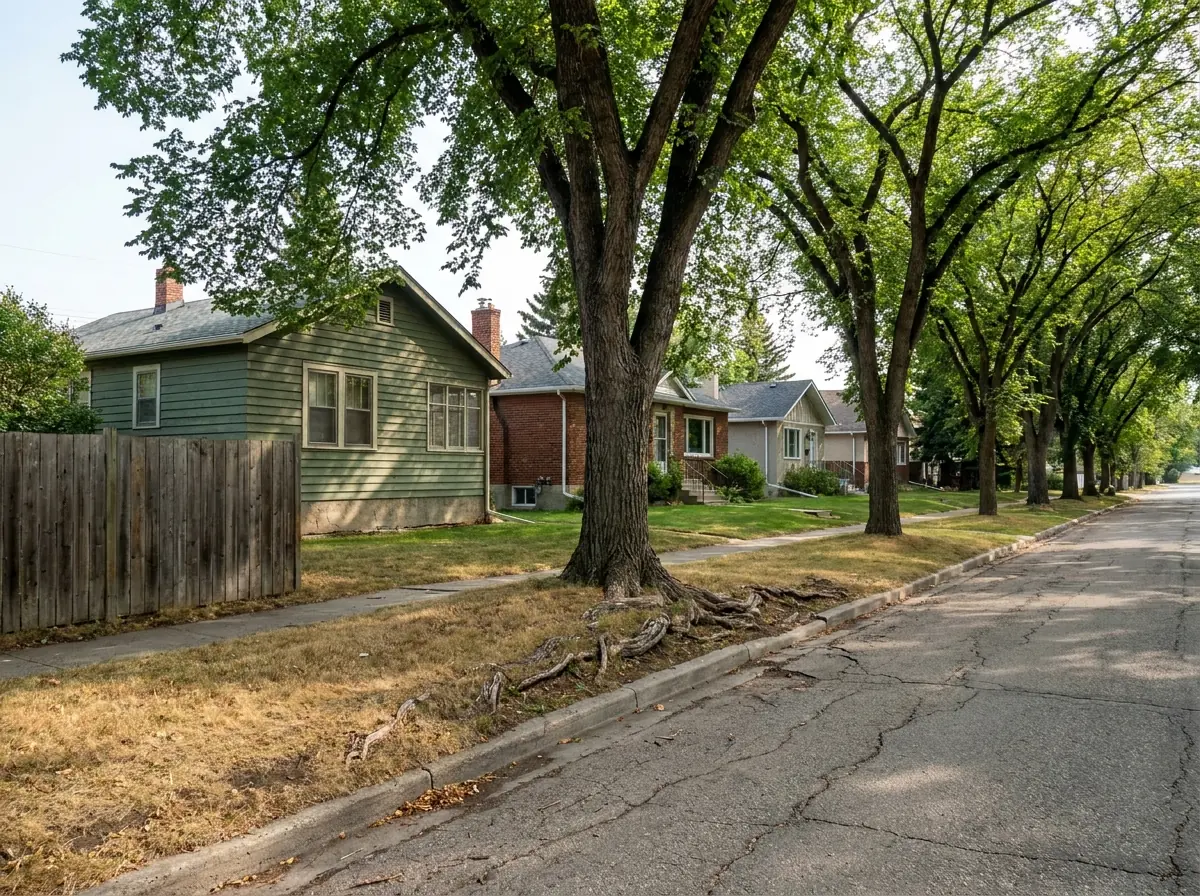
Some of the oldest residential stock in Calgary sits in the inner southwest, and so does the heaviest boulevard tree canopy in the city. That combination — clay laterals with a joint every few feet, under streets lined with mature elm — produces the most predictable root intrusion pattern we see anywhere. It is also where trenchless earns its keep most obviously, because the surface above those lines is exactly what nobody wants to dig up.
The inner southwest is the one part of Calgary where we do not really wonder what is buried. Between the escarpment streets and the ridge above the Elbow, the residential stock predates the plastics era comfortably, and the working assumption on a sanitary lateral here is vitrified clay until a camera says otherwise. What makes this quadrant distinct is not that assumption on its own — parts of the southeast and northwest share it — but that it lands under the densest mature boulevard planting in the city. Old pipe and old trees arrived together and have been in contact for a very long time.
Clay does not fail the way homeowners expect it to. It fails at the joints, not in the middle of the pipe. Every joint is a seam a root can find, and a mature boulevard tree has had decades to find all of them. Joints also offset as the ground moves, leaving a lip that catches everything passing over it. The practical consequence is that a failing southwest lateral has a rhythm to it on camera: intrusion appearing at a regular interval down the run, with clean pipe between. That rhythm is also why the diagnosis matters more here than anywhere else in the city. A line with intrusion at every joint along its length is a different job from a line with two bad joints and forty feet of sound pipe between them, and the second one is far more common than the sales pitch suggests. Where it is two joints, a spot repair is the whole job and we will say so.
The second variable is the surface. Southwest lots in the older communities are narrow, frequently lane-accessed, and the ground above the lateral is likely to be a stone walk, a mature perennial bed, a retaining wall or the roots of the very elm causing the problem. That is the argument for trenchless here and it is a real one — but it cuts the other way too. Clay is the best trenchless host material there is: it is round, it holds its shape, and it breaks cleanly. It takes a liner well and it bursts predictably, so the camera decides which is cheaper rather than which is possible. And where a lot genuinely cannot take a rig and its access pits, we will tell you that open-cut is the cheaper answer rather than forcing a method onto a site that will not have it.
Most likely under a Southwest Calgary property
Ordered most to least likely, with how each one fails. This is a generalisation about an area and never a statement about one address.
- Vitrified claycommonly found in homes built before roughly the 1960s, and in some areas later than that
- It fails at the joints, not in the middle of the pipe. Every joint is a seam a root can find, and a mature boulevard tree has had decades to find all of them. Joints also offset as the ground moves, leaving a lip that catches everything passing over it.
- Cast ironcommon in mid-century construction, and still found in buildings of that period today
- It corrodes from the inside out. Scale builds on the pipe wall and narrows the bore until a line that was four inches is effectively passing two, and eventually the bottom of the pipe — where the flow sits — corrodes through entirely while the crown still looks fine.
- Copperthe common water service material through much of the later twentieth century and still installed today
- Pinhole leaks. Copper corrodes from the outside where soil chemistry is aggressive to it, and from the inside where water chemistry is. A service can leak for a long time underground before anything shows at the surface.
- PVCcommon from roughly the 1970s and 1980s onward, and the default in newer construction
- Same story as ABS — the pipe outlives the problem. Bellies from poor bedding, crushing from heavy equipment over a shallow run, and root intrusion at a gasketed joint that was not seated properly.
Material and era are trade generalisations, not a record of what is under any particular property. What is actually in the ground at an address is settled by a camera, not by the year the house was built.
Who calls us from Southwest Calgary, and why
Two kinds of caller dominate here. The first has lived in the house long enough to have a history with the line: cleared once a few years ago, cleared again last spring, and now watching the interval shorten. That pattern is the single most reliable indicator we have that the problem is structural rather than incidental, and it is worth more diagnostically than the age of the house. The right next step is a camera run, not another clearing, because another clearing buys a season and tells you nothing new.
The second is a buyer or their agent, ahead of possession on a character home. A pre-purchase camera inspection of the lateral is a routine request in this part of Calgary and it should be — the line is the one major system in an old house that a home inspector cannot see and the seller usually cannot describe. We run the camera, record what is there, and give you a plain reading of it. Sometimes that reading is that the line has decades left in it. Buyers are entitled to hear that too.
Specific to Southwest Calgary
- Two bad joints is not a replacement
- Clay fails in specific places, not along its whole length, and the most common honest finding on an older southwest line is localised damage in an otherwise sound run. Spot repair exists for exactly that and it is a fraction of the disruption.
- The tree usually stays
- Root intrusion is a joint problem, not a tree problem. Replacing the jointed run with a fused one removes what the roots were entering; the elm above it is not the thing that needs to change, and removing it would not fix a line that is already offset.
- Lane access decides the method
- Narrow frontages, detached garages off the lane and heavily landscaped side yards limit where a pit can physically go. On some southwest lots that rules a method out before the camera has been down the pipe, which is why we walk the site as well as the line.
- Older stock also means older water services
- Sewer is not the only buried line in these communities. Pinhole leaks. Copper corrodes from the outside where soil chemistry is aggressive to it, and from the inside where water chemistry is. A service can leak for a long time underground before anything shows at the surface. Because a copper service is usually one continuous run with no buried joints, a leak on it is located acoustically rather than by digging to look.
Permits and the authority
Permitting here goes through the City of Calgary. The southwest raises that earlier than other quadrants for a reason that has nothing to do with the pipe: on a narrow lot with lane access, the only place to put an access pit may be close to the boulevard or the street, which puts the work in front of the City rather than entirely on private ground. We confirm that with the City before we commit to a method, along with the prior question of where the property owner's length of pipe actually begins and ends — an answer that comes from the City for your specific address, never from a contractor's assumption.
Communities and districts we work in
Elbow Park · Upper Mount Royal · Scarboro · Bankview · Sunalta · Altadore · Killarney · Britannia · Windsor Park · Rideau Park · Richmond · Shaganappi · Lakeview · Glenbrook · Glamorgan · Oakridge · Braeside · Signal Hill
What we do in Southwest Calgary
Trenchless Sewer Repair
Sewer lines replaced from two pits, not a trench.
Drain Cleaning
Drains cleared, and an honest answer on why.
Water Line Replacement
New water service pulled through, lawn intact.
Water Line Repair
One leak in sound pipe is a repair, not a rebuild.
Commercial & Multi-Residential
Underground work scheduled around your tenants.
Every one of those pages describes the same work wherever it is done. What changes in Southwest Calgary is which of them you are likely to need, and that is what the rest of this page is about.
Questions we get asked everywhere
The general questions have the same answers in Southwest Calgary as they do anywhere else, so they are answered once, in full, on one page rather than restated here with the place name changed.
Next door
Tell us what the line is doing
What came out, where, and roughly how old the house is. Those three answers decide what gets loaded before anyone leaves the yard.