Sewer Camera Inspection
See the problem before you pay to fix it. A push camera and a sonde locate find the defect and tell you how deep it is and how far out.
Two people book this and they want opposite things. One is holding a quote for a sewer replacement that arrived with no evidence attached — a large number, a confident diagnosis, and nothing to look at — and wants to see the pipe before agreeing to anything. The other is partway through buying a house on an older street, has a window closing, and would like to know what is between the basement wall and the street before they sign something that makes it theirs.
Both of them are really asking the same question, which is whether this is a blockage or a failure. Those two words are separated by an enormous amount of money and nothing else can tell them apart. Root masses entering at regular intervals, matching the joint spacing. Offset joints showing a step in the pipe wall. Often a long run of sound pipe between two bad joints. Long clean runs. A defect in PVC is usually one identifiable event at one location, not a line-wide condition. An unmistakable oval or egg-shaped bore. Blistering and peeling of the inner wall. Often the camera simply cannot pass. One of those is a cleaning, one is a repair and one is a replacement, and they can all produce the same slow drain in the same basement.
The report from that visit belongs to you. Footage of the run, the located position and depth of anything found, what the pipe is made of, and what each available option would actually involve — written down, handed over, and yours to take anywhere, including to whoever gave you the quote you did not believe. It is not released on condition that the repair is booked with us, and it is not edited to make a case. A condition report that only exists to justify the next invoice is not a report.
How camera inspection runs, step by step
-
Step 1
Access the line
Normally through an existing cleanout. Where there is not one, we find the best access that does not mean opening anything.
-
Step 2
Run the camera
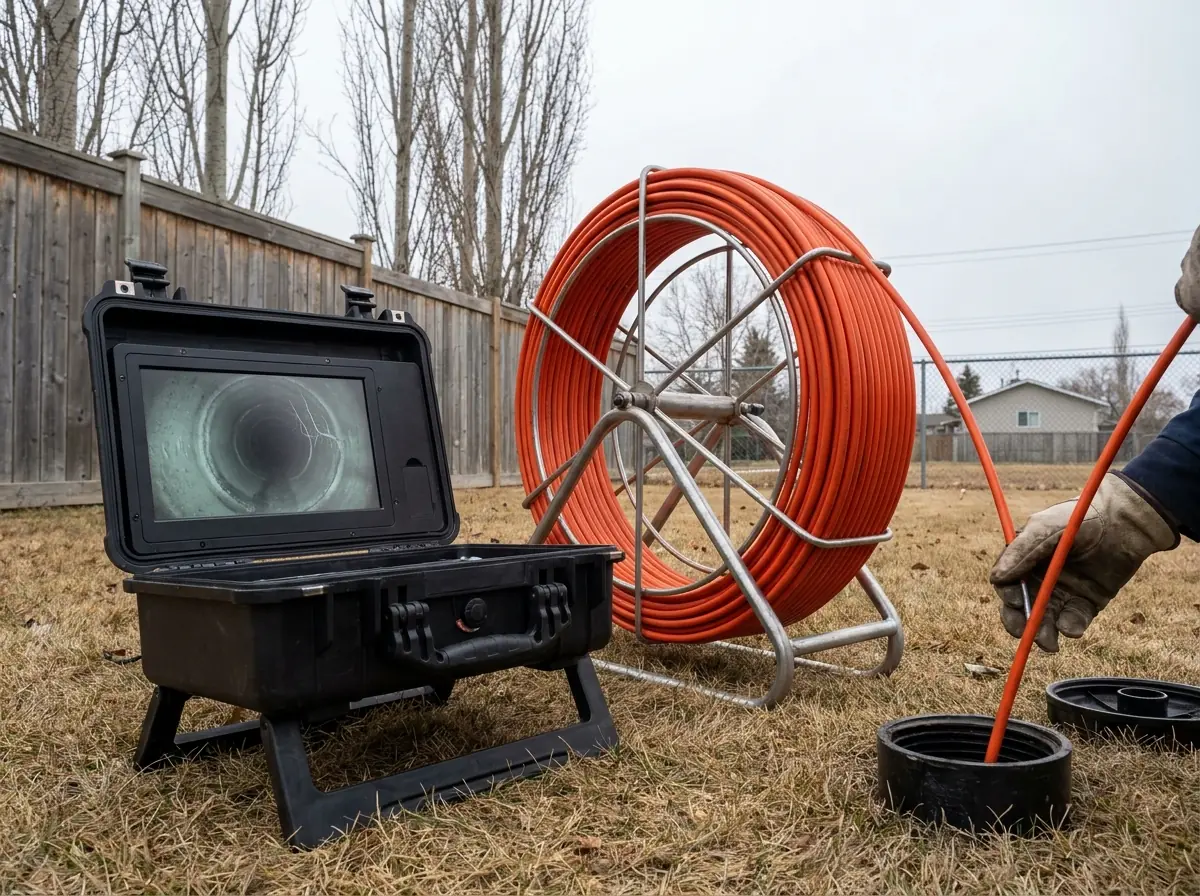
The camera goes the length of the lateral. You watch it live rather than being handed a verdict afterwards.
-
Step 3
Locate the defect
A sonde in the camera head is tracked from the surface, so a defect is marked with a depth and a position in the yard, not a guess.
-
Step 4
Identify the material
What the pipe is made of is as important as what is wrong with it, because it decides which repairs are even available.
-
Step 5
Written condition report
Footage, the located position, the material, and what each option would involve. Yours to take to anyone.
What the day actually looks like
It normally goes in through an existing cleanout, which means nothing is opened and nothing is dug. The camera is pushed the length of the lateral slowly, and you watch the same screen the operator does, live, while it happens. That part matters more than it sounds: a verdict delivered afterwards from a van is a description of footage, and a description of footage is exactly what the reader with the unbelievable quote already has. Expect the operator to stop, reverse, and go over the same two feet three times — that is what reading a pipe looks like, and the interesting places are the ones worth being slow at.
Then the locate, which is the part people remember. A sonde in the camera head transmits from wherever it has stopped, and it gets tracked from the surface with a receiver until the defect is standing under somebody's feet in the yard, with a depth. That is the difference between knowing something is wrong at a certain distance along the pipe and knowing it is under the driveway, at a given depth, a specific number of paces from the back step. Every decision that follows — method, pit placement, what has to come up — is made from that mark.
What decides the scope
What makes one inspection straightforward and another one difficult is almost always access. An existing cleanout in an accessible place is the easy version. No cleanout means finding another way in, and sometimes it means opening something, which changes the job. Length of the run matters, and so does condition: a line packed with grease, scale or standing water shows you very little, and sometimes the honest sequence is to clean it first and then look, because what a jetter takes off the pipe wall is the same material standing between the lens and the pipe wall. That ordering runs the other way too, and it is the more important direction: A pipe sound enough to take the pressure. This is why the camera goes in first.
Material changes what a camera is even for. A sanitary lateral is what this equipment is built to inspect. Buried water services are not: Not a camera job — water services are too small. Leaks are found by acoustic detection, pressure test and correlation, not by looking down the pipe. If the question is about pressure, a leak in the front yard or a water line rather than a sewer, a camera down the sewer is the wrong tool and will not answer it, and that is worth establishing on the phone rather than on site.
What people get wrong about this
A camera that cannot pass is a finding
It feels like a failed inspection and it is the opposite of one. A head that will not go past a certain point has told you there is something there solid enough to stop it, and where. It deforms before it breaks. The pipe goes oval under soil load, then blisters and delaminates from the inside, then collapses. A line can lose most of its cross-section while still technically being a pipe.
Footage with no locate is half a report
A recording on its own tells you what is wrong and roughly how far along. It does not tell you where that is in the yard or how deep, and without those two facts nobody can price a repair or tell you whether the defect sits under the driveway or under the lawn. If you are given video and no located position, you have half of what you paid for.
It is a condition report, not a pass or a fail
Buyers especially want a yes or a no and there is not one. What comes back is a material, an age-appropriate condition, and a list of what is present. A rough, tuberculated interior that snags the camera. Channelling along the invert where the bottom has worn away. The pipe can look intact from above and be gone underneath. That is a real finding and it is not a verdict on the house — it is information you can put a number against and negotiate with.
For a buyer, the timing is the whole value
A scope run while there is still an inspection condition on the offer is information you can act on. The same scope run after possession is information you can only pay for. If the street is old and the trees are older, this is the cheapest thing on the inspection list and the only one that looks at the part of the property nobody can see.
When this is the wrong answer
Two cases where you should not book this with us. First: if another contractor has already run a camera down that line recently, ask them for the recording and the located position before you pay anybody to do it again — most will hand it over, it is your line and your money that paid for it, and a contractor who will not release footage of a pipe they want to replace has told you something useful for free. Second: if one fixture is slow and everything else in the house drains normally, that is almost certainly not the buried lateral at all — it is a problem inside the house, closer to the fixture than to the street, and a scope of the main line will tell you nothing except that the main line is fine. Get the fixture looked at first.
Questions about camera inspection
The ones that come up on this work specifically. The general questions are answered on the FAQ page.
Do I get to see the footage?
Can you survey a line that is backed up right now?
Can you camera a water service?
What does a survey not tell you?
People also ask
Answered in full, once, on the page each one belongs to — rather than repeated on every page of this site.
Nothing is quoted off a description
The camera goes down first and you keep the footage. If the answer is that there is nothing wrong with your line, that is what you will be told.