Leak Detection
Finding a buried leak before digging for it. A water bill that climbed with no change in use is the usual reason people call.
The usual reason for this call is a bill. Nothing changed about how the house is used, nobody filled a pool, and the number went up and stayed up. That is a genuinely difficult symptom, because a toilet with a worn flapper and a buried service that has opened up look exactly the same on a statement — both are water passing the meter that nobody used. One of them is a part you can hold in your hand. The other is an excavation. Deciding which of the two you have is the entire job, and it comes before any of the equipment comes off the truck.
The second reason is physical: a wet patch that will not dry, grass that stays green through a dry week, a soft area in a driveway, or a running sound in the house with every tap closed. These are more convincing than a bill but they are worse evidence about location, because water under pressure surfaces where the ground lets it rather than where it escaped.
Note what is not on this list: a camera. Not a camera job — water services are too small. Leaks are found by acoustic detection, pressure test and correlation, not by looking down the pipe. That is the honest limit of the method and it is worth stating, because a reader who has seen the sewer side of this site will reasonably ask why the line cannot simply be looked down. On a water service there is nothing to look down and the finding has to be done from outside the pipe.
How leak detection runs, step by step
-
Step 1
Isolate the loss
Shut everything off and watch the meter. If it still moves, the loss is between the meter and the fixtures — or outside entirely.
-
Step 2
Rule the house out
A running toilet and a failing service look identical on a bill. The cheap causes get eliminated before anyone talks about excavation.
-
Step 3
Acoustic survey
Escaping water under pressure makes a sound that carries along the pipe. Listening along the run narrows where it is coming from.
-
Step 4
Correlate and mark
The position is fixed and marked on the surface, with a depth, so what follows is one hole in a known place.
What the day actually looks like
It starts at the meter with everything in the building shut off, which sounds trivial and is the most informative minute of the visit. If the register still moves, water is passing the meter with nothing drawing it, and that is the difference between a real investigation and an expensive walk around the yard. The next step is elimination rather than detection: toilets, a softener stuck mid-regeneration, a humidifier bleed, an irrigation zone valve that is not fully seating, an outside tap, a pressure-relief discharge. Those are cheap, common, and account for a large share of the calls that start with a bill. We would rather spend twenty minutes proving the loss is inside the house than sell a survey of the yard.
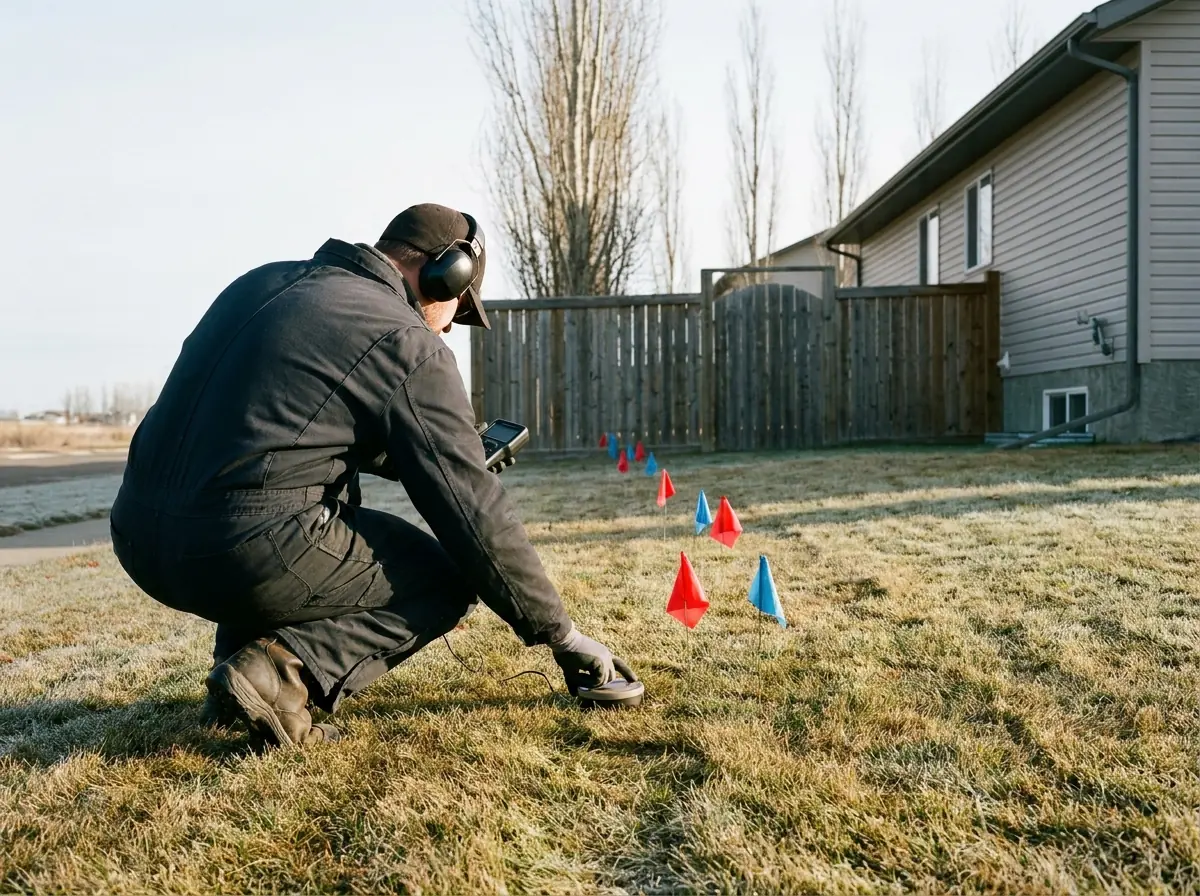
Only once the house is ruled out does the equipment come out. Water escaping a pressurised line makes noise at the point of escape, and that noise carries along the pipe wall and through the ground. The survey listens at contact points along the run — the shutoff at the property line, the point of entry, anything metallic tied to the service — and then correlation narrows the position by comparing what two listening points hear and when. The output is a mark on the surface and a depth, so that what follows is one hole in a known place. Conditions matter here in a way they do not on most trades: a quiet street and a still house make a faint leak findable, and the same leak at a busy hour can be inaudible. That is one of several reasons this work sometimes happens at an odd hour.
What decides the scope
What decides whether a leak is easy or difficult to find is mostly the physics of sound, not the size of the leak. Metal carries it well — a leak on copper or on galvanized steel is usually traceable a long way along the pipe. PVC and other plastics damp it heavily, so a plastic service can be quiet at the same escape rate. Depth works against you, saturated ground works against you, and a large break can genuinely be harder to hear than a small one because a slow escape through a small opening is what produces the sharp hiss the correlator is looking for.
What is above the line is the other variable. A hard surface transmits and reflects differently from open lawn, a service that runs under a driveway or a walk has fewer accessible contact points, and a leak whose water finds its way into a gravel bed, a footing drain or an adjacent utility trench may never present at the surface at all. None of that makes a leak unfindable; it changes how long the finding takes, and it is the part of the work worth paying for, because every hour spent narrowing the position is an excavation that does not have to be widened later.
What people get wrong about this
Dig at the wet spot and you will usually miss
Water follows the easiest path available — the original service trench, a bedding layer, a drain — and emerges wherever that path releases it. The surfacing point can be a long way from the failure and often sits downhill of it. Opening the ground where the water shows is the most common way a single repair turns into a series of holes.
There is no camera for this
Cameras are a sanitary-drain tool. A water service has no room for one and no access to put one in, so anybody offering to camera your water line is describing a different job. Water leaks are found acoustically, by pressure behaviour and by correlation, and the honest version of this page says so rather than borrowing the credibility of the sewer equipment.
A summer bill spike is usually irrigation
Seasonal jumps track outdoor use far more often than they track buried failures. A controller running a zone at an hour nobody is awake for, a valve not seating, or a hose left cracked open will all reproduce the symptom. Check the season before assuming the service. A buried leak that is genuinely running does not take the winter off.
Detection is not the repair, and it is not free of them
Locating tells you where and roughly how deep. It does not tell you whether the pipe is worth repairing — that is settled when the line is exposed and the metal either side of the failure can be seen. Expect the position first and the repair-or-replace decision second, at the hole, not before it.
When this is the wrong answer
If the meter is completely still with every fixture and appliance shut off, you do not need this service and we will say so at the door. The loss is either inside the building or it is not happening, and the next step is a plumbing check indoors rather than a survey of the yard. If the building is on a shared or unmetered supply, the meter test is unavailable and the investigation is different and harder — worth knowing before booking. And if what you actually have is water appearing in a basement, that is more often a drainage or a sanitary issue than a supply one, and starting with a leak survey of the front yard is starting in the wrong place.
Questions about leak detection
The ones that come up on this work specifically. The general questions are answered on the FAQ page.
How is a buried leak actually located?
Why not just dig where the ground is wet?
What if the leak cannot be found?
People also ask
Answered in full, once, on the page each one belongs to — rather than repeated on every page of this site.
Nothing is quoted off a description
The camera goes down first and you keep the footage. If the answer is that there is nothing wrong with your line, that is what you will be told.