Trenchless Sewer

CIPP Lining

A new jointless pipe cured inside the old one. The failure mode that killed the original line — open joints — no longer exists in what replaces it.

It comes back every year, usually in spring, and by now you can predict it. The basement shower drains slowly, then the floor drain gurgles when the washing machine empties, then somebody comes out with a cutting head on a cable and clears it, and for most of a year everything is fine again. The invoice is never large enough on its own to make you do anything about it. That is exactly what makes it expensive — it is an annual subscription to a problem, renewed by the tree on the boulevard.

Nothing about that cycle is a mystery and nothing about it is going to stop on its own. Vitrified clay is commonly found in homes built before roughly the 1960s, and in some areas later than that. It fails at the joints, not in the middle of the pipe. Every joint is a seam a root can find, and a mature boulevard tree has had decades to find all of them. Joints also offset as the ground moves, leaving a lip that catches everything passing over it. Cutting the roots out removes what has grown in since last time; it does not close the way in. Where roots are the problem, jetting treats the symptom. They grow back, and the joint they are entering through is still open. Lining is the answer to the joint rather than to the roots: A resin-saturated liner is pulled or inverted into the existing pipe, pressed against the host wall, and cured in place. What results is a new jointless pipe formed inside the old one. Because it has no joints, the failure mode that killed the original line no longer exists.

What are the disadvantages of CIPP lining? Five real ones, and the important two are that there has to be a pipe left to line, and that a liner copies the shape of whatever it is cured inside. So a collapse rules it out, a belly stays a belly, the finished bore is fractionally smaller, every branch connection it covers must be reopened afterwards, and it is a sewer method only — water services are never lined.

How cipp lining runs, step by step

  1. Step 1

    Survey and measure

    The line is cameraed and measured. A liner is cut for the run it is going into, so the survey is the specification.

  2. Step 2

    Clean and cut back

    Scale, grease and root mass come out first. A liner pressed against a dirty pipe wall is a liner that will not bond to it.

  3. Step 3

    Set the liner

    The resin-saturated liner is drawn or inverted into the pipe and pressed out against the host wall along the full length.

  4. Step 4

    Cure

    The resin hardens in place against the old pipe. The line is out of service while that happens and back in service once it is done.

  5. Step 5

    Reinstate and verify

    Any branch connection the liner covered is reopened, and the finished bore is put back on camera end to end.

What the day actually looks like

Most of the day is cleaning, which nobody expects. A clean bore. The line is cleaned and, where there is scale or root mass, cut out before anything is lined. Scale, grease and the root mass at each joint have to come out completely first, because resin pressed against a dirty wall does not bond to the pipe, and on a line that has been rodded for years there is more in there than the rodding ever removed. That stage is noisy, wet and slow, and it is also the stage that occasionally ends the job: a pipe wall that looks acceptable under scale sometimes turns out, once it is clean, not to be sound enough to line. If that happens you find out before anything is committed rather than after.

Then the cure, which is the part of the day where nothing appears to be happening at all. The liner is set against the host wall along the full run and the resin hardens in place while the crew watches instruments outside. The line is out of service for the whole of it — no sinks, no toilets, no laundry, and that restriction is the real inconvenience of the job rather than anything happening in the yard. How long that takes depends on the resin system and the length of the run, so you will get the figure for your line before the day rather than a general one. Usually the least invasive option available, often reached through an existing cleanout with little or no excavation. The line is out of service while the liner cures.

What decides the scope

The host pipe decides availability before length decides anything. A host pipe that holds its shape. The liner follows the host while it cures, so the host has to be there to follow. Vitrified clay is the ideal case. Cast iron is a qualified yes and the qualification is real: Lining works only if enough sound wall remains to carry the liner while it cures, and heavy channelling can mean there is not. Descaling first is often required, and sometimes descaling is what reveals the pipe is past lining. Orangeburg is a flat no. It deforms before it breaks. The pipe goes oval under soil load, then blisters and delaminates from the inside, then collapses. A line can lose most of its cross-section while still technically being a pipe. And a plastic line with a belly in it is a no for the same reason a spirit level does not fix a sagging floor. Standing water sitting in a low spot with the pipe wall sound either side of it. Clean pipe with one specific defect, rather than a line failing all over. A liner follows the host, so the water would still be sitting in exactly the same place afterwards.

After that it is length, access and connections. A run reachable through an existing cleanout avoids excavation entirely, which is the best-case version of this job; no cleanout means opening something to get in. Every branch joining the lined section is one more reinstatement afterwards, so a straight lateral with nothing tying into it is a simpler specification than the same length of pipe under a house with an addition on it. And the survey is the specification — the liner is made for the run it is going into, which is why the camera comes first and why a length quoted off a description is a guess with a decimal point on it.

What people get wrong about this

The disadvantages, in full and unedited

It cannot fix a collapsed pipe. There has to be a pipe left to line. It reproduces the geometry it is given. A bellied line stays bellied, and water will still stand in the same low spot afterwards. The liner takes up wall thickness, so the finished bore is slightly smaller than the original — normally irrelevant, occasionally not. Every branch connection along the lined section is covered by the liner and has to be reinstated afterwards, which is a separate operation. Not used on water services. Lining is a sewer method.

Cleaning is the job, not the prep

People budget for the liner and treat the cleaning as a formality. It is neither quick nor incidental, and on a badly scaled cast iron line it can be most of the work. It corrodes from the inside out. Scale builds on the pipe wall and narrows the bore until a line that was four inches is effectively passing two, and eventually the bottom of the pipe — where the flow sits — corrodes through entirely while the crown still looks fine.

Lining part of a failing line just moves the appointment

A short liner over the one joint that keeps failing is a legitimate repair when the rest of the run is genuinely sound. When it is not, it buys a year. It fixes one place. A line with defects at six joints does not want six patches — at some point the full-length answer is both cheaper and better. It does nothing for the joints it does not cover, so a deteriorating clay line will keep producing new defects.

A lined pipe still needs looking after

Lining removes the joints; it does not remove grease, wipes or a fixture that has always drained badly. The new bore is smooth and jointless, which makes it far harder for roots to get in and far easier to clean when something else does go down it — not a line that can never block again.

When this is the wrong answer

Lining is wrong more often than method pages admit, and the camera usually makes that obvious in the first minute. A collapsed, severely deformed or bellied line. Lining those buys a new pipe with the old pipe’s problem moulded into it. A collapsed or deformed line is a bursting or a dig conversation: A line that is failing along its whole length, or one too deformed or collapsed to line. One defect in sound pipe is a spot repair, not a full-length liner, and paying to line eighty feet to fix two of them is buying far more than the problem requires. And if the footage shows a modern plastic lateral with a single blockage in it, you do not need a liner or a replacement — you need the line cleaned, once, and somebody honest enough to tell you the pipe is fine.

The method itself, including what it cannot do

Every method we use is defined in one place, so the page describing it and the page comparing it cannot disagree. The limitations below are part of that definition, not a disclaimer attached to it.

CIPP lining

Also called cured-in-place pipe, pipe lining, sewer relining

A resin-saturated liner is pulled or inverted into the existing pipe, pressed against the host wall, and cured in place. What results is a new jointless pipe formed inside the old one. Because it has no joints, the failure mode that killed the original line no longer exists.

What it needs from the existing line

  • A host pipe that holds its shape. The liner follows the host while it cures, so the host has to be there to follow.
  • A clean bore. The line is cleaned and, where there is scale or root mass, cut out before anything is lined.
  • A camera survey before and after. Lining a pipe you have not looked down is guesswork.

What it cannot do

  • It cannot fix a collapsed pipe. There has to be a pipe left to line.
  • It reproduces the geometry it is given. A bellied line stays bellied, and water will still stand in the same low spot afterwards.
  • The liner takes up wall thickness, so the finished bore is slightly smaller than the original — normally irrelevant, occasionally not.
  • Every branch connection along the lined section is covered by the liner and has to be reinstated afterwards, which is a separate operation.
  • Not used on water services. Lining is a sewer method.
What the property looks like
Usually the least invasive option available, often reached through an existing cleanout with little or no excavation. The line is out of service while the liner cures.
Right when
A structurally sound but leaking pipe — the classic case being clay with root intrusion at the joints and good pipe in between.
Wrong when
A collapsed, severely deformed or bellied line. Lining those buys a new pipe with the old pipe’s problem moulded into it.
Spot repair

Also called sectional liner, point repair, sectional patch

A short liner placed over one defect rather than the whole run. The rest of the line is left exactly as it is, because the rest of the line is fine.

What it needs from the existing line

  • A defect that is genuinely local, confirmed on camera and located precisely.
  • Sound host pipe either side of the defect for the patch to seal against.

What it cannot do

  • It fixes one place. A line with defects at six joints does not want six patches — at some point the full-length answer is both cheaper and better.
  • It does nothing for the joints it does not cover, so a deteriorating clay line will keep producing new defects.
What the property looks like
Typically the smallest job on this list, and often reached through an existing cleanout.
Right when
One crack, one offset joint, or one root intrusion in an otherwise sound line.
Wrong when
A line that is failing generally. Patching a worn-out pipe is money spent on the next failure rather than on this one.

Side by side with the alternatives, and when the answer is a dig →

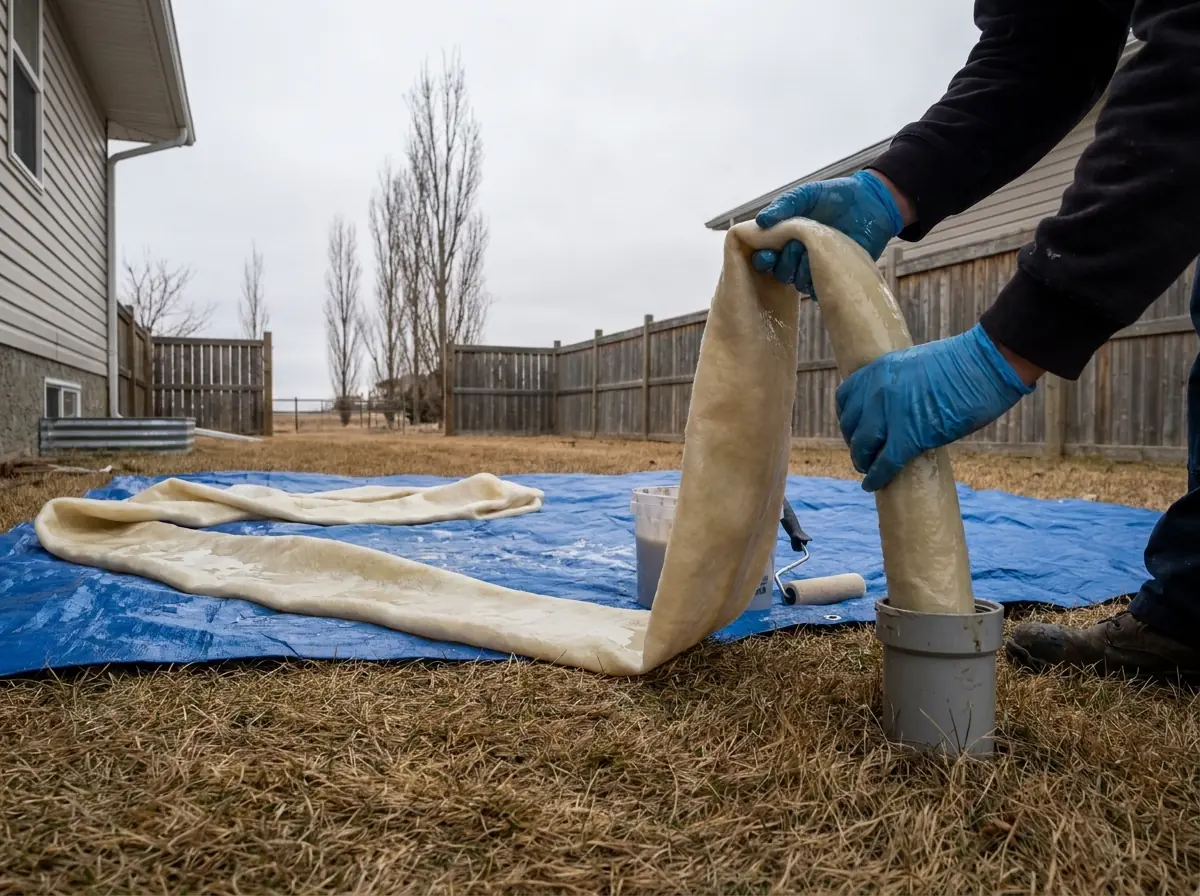
A resin-saturated CIPP liner being fed by gloved hands into a sewer cleanout at ground level.
A resin-saturated liner being fed into a cleanout

People also ask

What are the disadvantages of CIPP lining?

Five. It cannot fix a collapsed pipe — there has to be a pipe left to line. It reproduces the geometry it is given, so a bellied line stays bellied. The finished bore is slightly smaller. Branch connections must be reinstated afterwards. And water services are never lined.

Questions about cipp lining

The ones that come up on this work specifically. The general questions are answered on the FAQ page.

Will lining fix a low spot where water stands?
No, and this is the one that costs people money. A low spot — a belly — is a bedding problem, not a pipe problem: the ground under the line settled and the pipe followed it. The pipe itself is often perfectly sound. A liner cures against the host and reproduces the geometry it is given, so what you get is a brand new jointless pipe with the old pipe’s low spot moulded permanently into it, and water standing in exactly the same place. That is a re-lay: bursting, or a dig. If a liner has been recommended and the footage shows standing water, ask about this specifically and get the answer in writing.
What happens to the connections along the lined section?
The liner is continuous and passes straight over them, sealing every opening where something else joins the line. Those openings are reinstated afterwards, and that is a separate operation with its own equipment and its own time rather than a detail of the lining. It should be itemised. On a single-family lateral there is often nothing to reinstate at all; on a larger building the branch count is effectively the scope, which is why commercial lining is a different conversation from a house.
How long does the liner take to cure, and what will I hear?
We are not going to describe that on a page, because the honest answer depends on the cure method used on your job and stating the wrong one would be worse than saying nothing. What is true whichever method is used: the line is out of service while the resin goes off, the work is frequently reached through an existing cleanout with little or no excavation, and the property is not opened up. You will be told which method your job uses, how long the line is down, and what is usable in the house before the work starts rather than on the day.
Does the pipe have to be cleaned before it can be lined?
Always, and on some materials the cleaning changes the answer. The liner presses against the host wall, so the wall has to be clean for it to bond against — roots are cut out, scale and grease are stripped off. On cast iron this matters more than anywhere else: the pipe has to be descaled before it can be properly assessed, and sometimes descaling is what reveals there is not enough sound wall left to carry a liner. Any lining scope committed to on cast iron before cleaning is a commitment made without the evidence.

Also asked on every job

Answered in full, once, on the page each one belongs to — rather than repeated on every page of this site.

Every question we are asked, and where each is answered

Nothing is quoted off a description

The camera goes down first and you keep the footage. If the answer is that there is nothing wrong with your line, that is what you will be told.