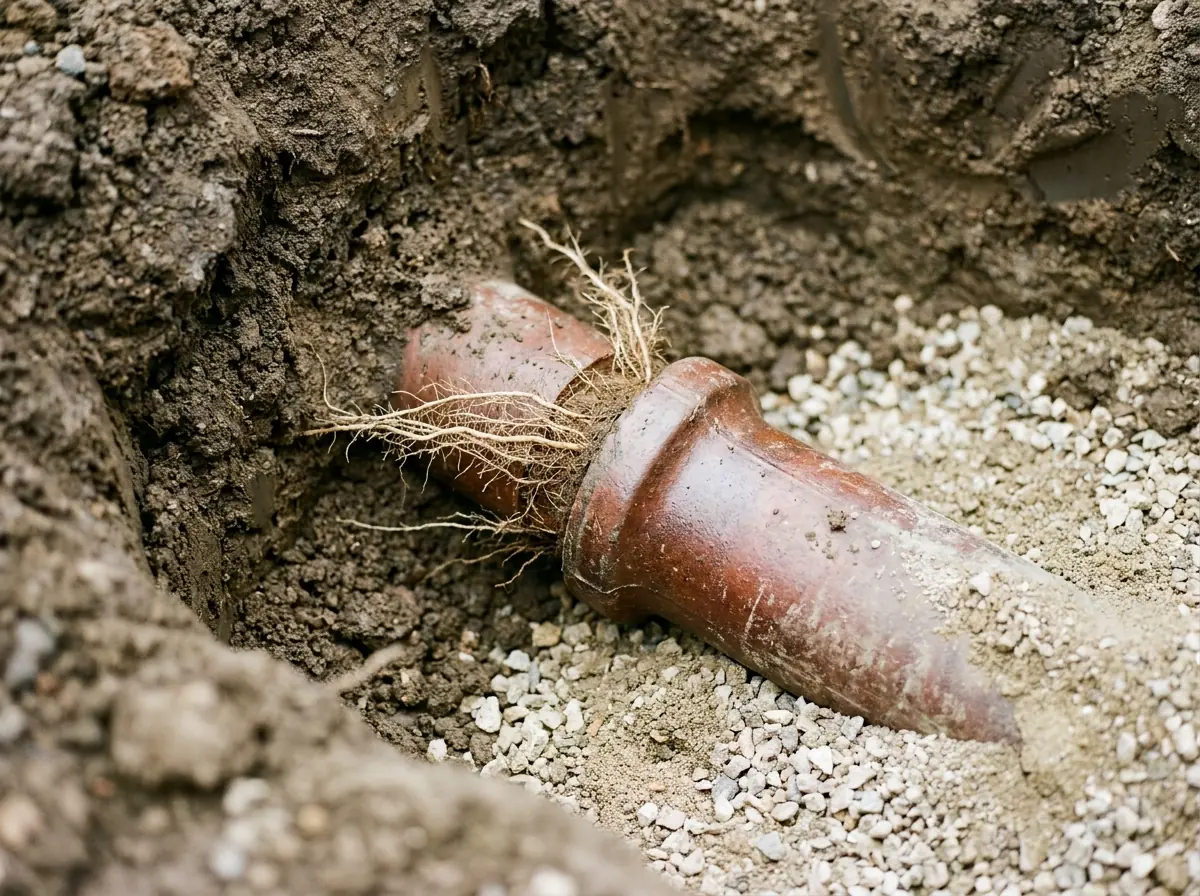
Clay sewer pipe in Calgary: why it fails at the joints
If your house is in one of the older parts of Calgary, there is a good chance the pipe carrying waste out to the street is fired clay. Not metal, not plastic. Clay.
People hear that and assume the material must be the problem. It is not. Understanding why is the difference between replacing a line that did not need replacing and lining one that did.
The material is not what fails
Vitrified clay is fired ceramic. It does not corrode. It is chemically inert against everything a house sends down a drain, including the things that eat cast iron from the inside and the sanitary gas that attacks concrete from the crown down. It does not care how old it is.
Our own material reference puts its service life this way:
often still structurally sound at a hundred years, provided the joints have held — age alone is not a reason to replace clay
Read the clause after the dash twice. Age alone is not a reason to replace clay. A contractor who quotes a replacement because the house is old, without showing you footage, is quoting the calendar.
What fails is the joint, and there are a great many of them
Clay pipe is laid in short lengths — commonly two to four feet — with a bell-and-spigot joint between every one of them.
Do the arithmetic on your own lot. A run from the house out to the connection, divided by a length of pipe that short, is a substantial number of joints. Every one of them is a seam.
Two things happen at seams.
Roots find them. A joint is the only opening in an otherwise sealed pipe, and what is on the other side of it is a warm, wet, nutrient-rich environment in ground that is otherwise neither. A fine root gets in, thickens, and levers the joint wider as it grows. On camera this is unmistakable: root masses entering at regular intervals, and the intervals match the pipe lengths.
Joints offset. Ground moves — freeze and thaw, settlement, load from above. When it moves, one length shifts against the next and leaves a lip inside the pipe. That lip catches everything passing over it, and a line that has caught things for long enough blocks.
Between two bad joints there is frequently a long run of perfectly sound pipe. That is the single most important thing to know about clay, because it determines what the repair is.
Why this is a Calgary problem specifically
Clay laterals are common anywhere with pre-1960s housing stock. What sharpens the picture here is what is growing above them.
Calgary carries one of the healthiest mature American elm populations left in North America — a genuinely unusual civic asset, and the reason the older streets look the way they do. An elm’s root system is broad, aggressive and patient, and it has had decades to work over the ground between your house and the street.
Put a mature elm over a jointed clay lateral and you have the textbook conditions for root intrusion, repeated, at every seam, for the length of the run. That combination is the reason so much of the sewer work in this city is concentrated in a few older communities rather than spread evenly across it.
One practical note: a boulevard tree may not be yours to make decisions about. Before anyone plans a trench that crosses a root plate, that is a question to put to the City rather than to your contractor.
What this means for the repair
Clay is, by some distance, the best trenchless host material there is. It is round, it holds its shape, and it breaks cleanly. That gives you both full-length options:
Lining. A cured-in-place liner forms a new jointless pipe inside the old one. Because it has no joints, the failure mode that killed the original line no longer exists. Clay with root intrusion at the joints and sound pipe in between is the textbook lining case.
Bursting. Pipe bursting fractures the clay outward and pulls a new fused HDPE pipe through in the same pass. Clay bursts predictably, which is not true of every material.
So on a clay lateral the camera is not deciding which method is possible. It is usually deciding which is cheaper and more appropriate for the specific pattern of damage — and that is a much better position to be in than the homeowner with Orangeburg, who has one option.
And a third answer exists. One offset joint, or one root intrusion, with sound pipe either side of it, is a spot repair. A short liner over one defect. The rest of the line is left exactly as it is, because the rest of the line is fine.
That said, know the limit of it. A line with defects at six joints does not want six patches. At some point the full-length answer is both cheaper and better, and a deteriorating clay run will keep producing new defects at the seams the patches did not cover. Where that crossover sits is a judgement made off the footage, not off a rule.
What about jetting the roots out
Hydro jetting cuts roots and cleans the pipe wall properly, and on a structurally sound clay line it is a legitimate and useful thing to do.
Understand what it is, though. Where roots are the problem, jetting treats the symptom. They grow back, and the joint they came in through is still open. If you are jetting the same line every year, you are buying the same day repeatedly, and that is the point at which lining stops being an expense and starts being arithmetic.
The other half of that warning matters more: jetting cannot be used safely on a pipe that is already failing structurally. A badly deteriorated line can be finished by the pressure. This is why the camera goes in first — not as an upsell, as a precondition.
The short version
Clay does not wear out. Its joints do, and it has one every few feet, and in the older parts of this city there is frequently a mature elm directly above them. The pipe between the bad joints is usually fine, which is why clay is the material trenchless methods were more or less invented for.
What you should not accept is a replacement recommended off the age of your house. Ask for the footage. Here is what it shows.
Want the line looked at?
Nothing here gets quoted off a description. The camera goes down first, you watch the screen, and you keep the footage — including on the jobs where the answer turns out to be that nothing needs replacing.