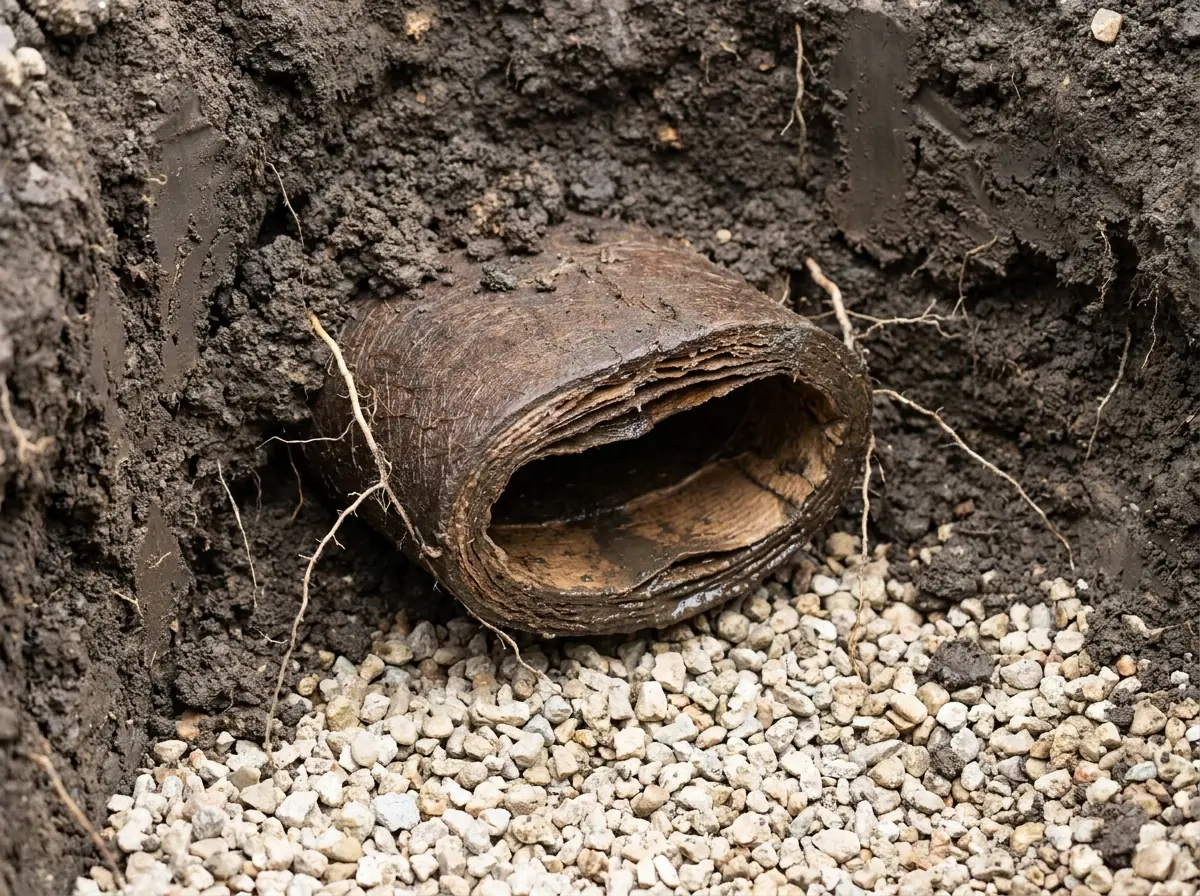
You have Orangeburg. Here is what your options actually are.
Most of the time a camera survey opens a conversation. It shows you a material, a pattern of defects and a set of trade-offs, and then somebody has to make a judgement about which method fits.
Orangeburg is the exception. When the camera finds Orangeburg, the conversation is mostly over before it starts, and the useful thing to understand is why — because the reason is also the reason a lining quote on an Orangeburg line should stop you cold.
What it is
Our material reference describes it plainly:
Wood pulp bound with coal tar pitch — cardboard, functionally. It was cheap, light and quick to install, and it was never going to last as long as the house.
It is commonly installed from roughly the 1940s into the 1970s. That is a trade generalisation about what gets found in the ground, not a record of what was permitted anywhere, and it is wide on purpose — the only thing that establishes what is under your lawn is looking at it.
It was not a scam and it was not a mistake at the time. It was a material that did a job cheaply during a period when a great deal of housing went up quickly. The problem is that it is still in service decades past the point anyone intended.
How it fails, which is the whole point
This is the part that decides everything downstream:
It deforms before it breaks. The pipe goes oval under soil load, then blisters and delaminates from the inside, then collapses. A line can lose most of its cross-section while still technically being a pipe.
Read that last sentence again. A line can lose most of its cross-section while still technically being a pipe.
Every other common sewer material fails by developing a hole, a crack or a gap. Clay opens at the joints. Cast iron corrodes through the bottom. Concrete loses its crown. In all of those cases the pipe is still round, and round is what a liner needs.
Orangeburg does not do that. It gets squashed. The load of the soil above it presses it out of shape over decades, and once it has gone oval it starts coming apart from the inside as the layers separate.
On camera:
An unmistakable oval or egg-shaped bore. Blistering and peeling of the inner wall. Often the camera simply cannot pass.
Nobody misidentifies it. That is one small mercy: an experienced operator knows Orangeburg on sight within a few feet of the pipe, and so will you once you see the footage. It does not look like any other pipe.
Why it cannot be lined
A cured-in-place liner is not a pipe you push into the ground. It is a resin-saturated sleeve that is pressed against the inside of the existing pipe and cured there. The old pipe is the mould.
That means two things have to be true of the host. It has to be there. And it has to hold its shape for as long as the resin takes to go off.
Deformed Orangeburg does neither reliably. Line an oval pipe and you get an oval liner — a brand new jointless pipe with the old pipe’s collapse moulded permanently into it. Line a pipe that is delaminating and you are curing resin against a surface that is coming away from itself.
So the verdict in our own material file is not conditional. It is no:
A liner needs a host that holds its shape while the resin cures, and deformed Orangeburg does not. Finding Orangeburg on camera effectively makes the decision: burst it or dig it, and bursting is almost always cheaper.
If somebody has quoted you a liner for a line they have identified as Orangeburg, ask them to explain that, and get the answer in writing. There is a narrow case — pipe that is still genuinely round — but it is narrow, and the footage has to show it rather than the quote asserting it.
So the options are two, not three
Burst it
Pipe bursting pulls a bursting head through the old line on a cable. The head fractures the Orangeburg outward into the soil and drags a new fused HDPE pipe in behind it in the same pass. The old material is not removed; it becomes part of the ground the new pipe sits in.
This is usually the right answer, and Orangeburg is one of the better materials to burst — it is not exactly structural to begin with.
It is not automatic, though, and here is what can stop it:
- A path the head cannot follow. Severe offsets can stop it, and an Orangeburg line that has partly collapsed can present exactly that.
- Clearance from other buried services. Bursting displaces soil sideways. Where another utility runs close and parallel to the run, that has to be established by locates before anything is pulled, and sometimes the answer that comes back is that it cannot be done safely. That is not a price negotiation.
- The two pits. Bursting is trenchless, not excavation-free. A pit is dug at each end, usually one at the house and one out at the connection, and those are real holes in real ground.
- Branch connections. Anything joining the run partway along is severed by the burst and has to be re-established separately.
Dig it
Sometimes digging is simply the better job, and an Orangeburg line has a few features that push it that way: the runs are often in older parts of town where lots are tight, and a line that has collapsed at one spot in the middle of the run may need to be reached directly.
Open-cut is also frequently the cheaper finished job on a short, shallow run under nothing but lawn — where the reinstatement that trenchless exists to avoid barely exists.
We have written the honest version of that argument as its own post: when you should just dig.
What does not help
Jetting it. Hydro jetting cannot be used safely on a pipe that is already failing structurally, and Orangeburg that has gone oval is the definition of failing structurally. High-pressure water can finish it. A company that will jet a line it has not looked down has decided your pipe is your risk.
Snaking it every spring. A cable through a deforming pipe buys you a few months and takes a little more of the wall with it each time.
Waiting. Most materials give you the option of managing the problem for a while. Orangeburg does not really have a stable phase — the deformation is progressive, and there is no version of the story where it stops.
The one genuinely good piece of news
Its lifespan is described this way:
frequently reaching end of life within thirty to fifty years, and any that remains in service is well past the age it was designed for
Which sounds like bad news, and is, except for one thing: it means you are replacing something that was always going to need replacing, once, with a material that is not going to ask again. What goes in is HDPE — fused, jointless between the pits, with nothing for a root to enter and nothing in ordinary service to corrode.
That is the only time this trade gets to say a job is finished.
What to do next
Get footage. Not a verbal identification over the phone, not an assumption from the age of the house, and not a conclusion drawn from a snake hitting something. The oval bore is unmistakable on a screen and it is what the whole decision rests on.
If it is Orangeburg, the conversation is bursting or digging, and which one is set by the path, the clearances and what is on the surface above the line.
Want the line looked at?
Nothing here gets quoted off a description. The camera goes down first, you watch the screen, and you keep the footage — including on the jobs where the answer turns out to be that nothing needs replacing.