Calgary and surrounding municipalities

Trenchless Sewer Repair

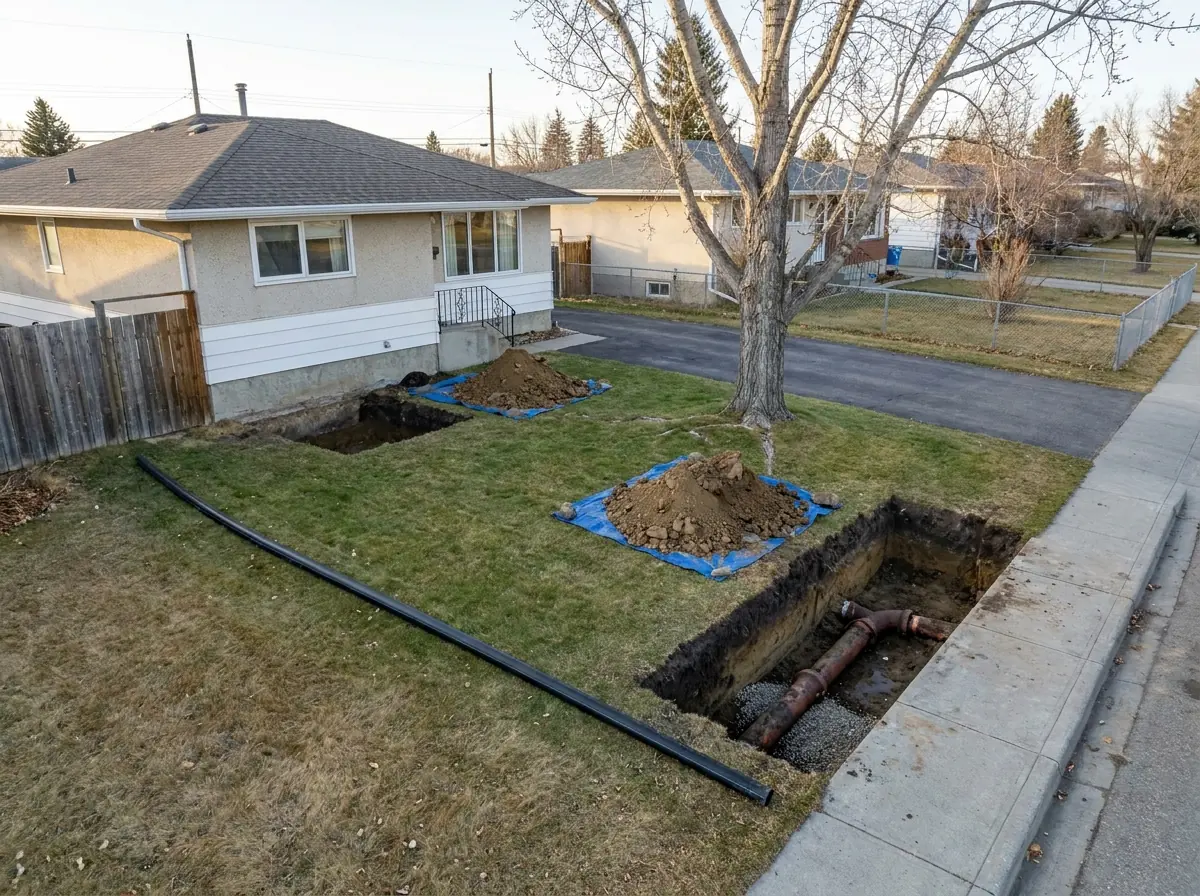
Calgary sewer lines replaced or relined from two small access pits instead of a trench across the yard. We camera the line first; the pipe decides the method.

Somebody has already told you the line is broken. Usually it was a drain cleaner who ran a rod out to a certain distance, felt it stop, could not get past it twice in a row, and said the word "collapse". Sometimes it is a floor drain that has backed up twice in a month and a plumber who will not come back for a third time. Either way, the sentence that follows is the reason you are reading this one: the yard is going to have to come up.

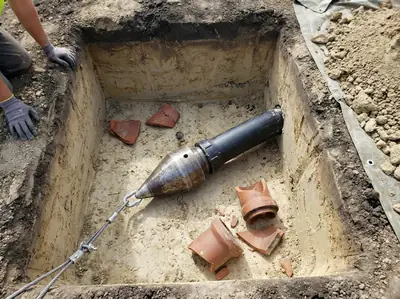
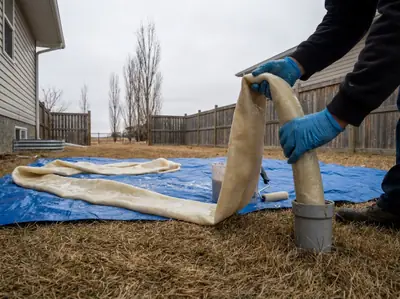
What is a trenchless sewer line? It is not a kind of pipe. It is a sewer line that has been rebuilt or replaced through small access pits at each end rather than through a trench cut along its length, so the ground in between is left where it is. Two methods do almost all of that work on a house lateral. Bursting pulls a new line through the old one. Lining builds a new pipe wall inside the old one. The camera decides which, because the existing pipe decides which.

Is trenchless sewer repair worth it? That turns almost entirely on what is sitting on top of the line. Under a driveway, a mature boulevard tree, a patio or a finished yard, not opening a trench usually saves more than the specialised equipment costs, because the reinstatement is the expensive half of a dug job. Over a short, shallow run through bare ground with nothing on it, digging is cheaper, and you should expect us to say so.

How trenchless sewer runs, step by step

  1. Step 1

    Camera the line

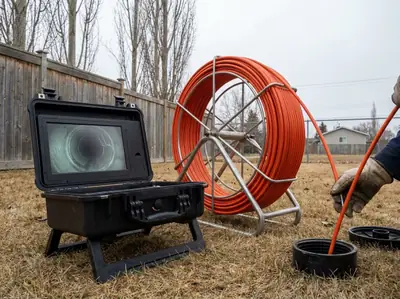
    Nothing is quoted off a description. A push camera goes down the line and we locate the defect before anyone talks about method.

  2. Step 2

    Identify the pipe

    What the line is made of decides what can be done to it. Clay, cast iron, Orangeburg and PVC each rule some options in and others out.

  3. Step 3

    Locates and pit layout

    Alberta One-Call locates cleared, then the two access pits are set where they do the least damage to what is on the surface.

  4. Step 4

    Line it or burst it

    A sound pipe with bad joints gets a liner. A collapsed or deformed one gets burst and replaced with fused HDPE in the same pull.

  5. Step 5

    Camera it again

    The same camera goes back down the finished line. You see the before and the after, not a description of them.

What the day actually looks like

This runs as two visits, not one, and they are deliberately separated. The first is a camera and a locate: the line is looked at end to end, the defect is marked with a depth and a position in the yard, and the material is identified. No method is named on the phone before that happens, because the three most consequential facts on the job — what the pipe is made of, where it has failed and what else is buried beside it — are all invisible until somebody looks. Between that visit and the work there is a locate request through Alberta One-Call that has to come back clear before anything is opened. We do not set that schedule and will not pretend to.

The work day itself is mostly not the part people picture. Two pits get dug and shored, the equipment is rigged, and then there is a long stretch where nothing visible happens while a crew watches a gauge or a winch line — that stretch is the job working, not the job stalled. Two pits rather than an open trench across the yard. Driveways, mature trees, patios and fences between the pits are generally left alone, which is usually the entire reason the method is chosen. Afterwards you are left with two reinstated pits rather than a scar down the middle of the lawn, and it is normal for the ground over a backfilled pit to settle a little in the first season and want topping up.

What decides the scope

The material settles the method before anything else does. Vitrified clay — commonly found in homes built before roughly the 1960s, and in some areas later than that — accepts either one. Clay is the best trenchless host material there is: it is round, it holds its shape, and it breaks cleanly. It takes a liner well and it bursts predictably, so the camera decides which is cheaper rather than which is possible. Orangeburg, commonly installed from roughly the 1940s into the 1970s, accepts only one: A liner needs a host that holds its shape while the resin cures, and deformed Orangeburg does not. Finding Orangeburg on camera effectively makes the decision: burst it or dig it, and bursting is almost always cheaper. ABS and PVC — common from roughly the 1970s and 1980s onward, and the default in newer construction — are usually not a repair conversation at all. Same story as ABS — the pipe outlives the problem. Bellies from poor bedding, crushing from heavy equipment over a shallow run, and root intrusion at a gasketed joint that was not seated properly. That is a cleaning or a single spot fix, and anyone selling a replacement into it has stopped reading the footage.

After material comes geometry and what is above the line: how long the run is, how deep it sits at each end, whether there is a cleanout to work through, whether a rig and two pits can physically reach both ends of a narrow lane-access lot, and what has to be taken up and put back if the answer turns out to be a dig. Where a new line is pulled in, the pipe that goes in is hdpe, and the reason that matters is the failure mode it does not have: a continuous smooth bore with no joints between the pits. What that costs is a separate conversation with its own page, because the honest answer to it is a list of drivers rather than a figure.

What people get wrong about this

A rod that stopped is not a diagnosis

A cable stopping at a certain distance tells you something is there at that distance. It does not tell you whether it is a root mass, an offset joint, a belly holding water or a genuine collapse, and those four have four different answers ranging from a cleaning to a full replacement. The distance is the only fact in that sentence.

Trenchless still means digging

Two pits get dug, they are real holes, and the one at the house end is often the bigger surprise because it lands in a flower bed or up against a foundation wall. Two pits still have to be dug. This is trenchless, not excavation-free, and the pits are real holes in real ground. What trenchless removes is the trench between the pits, which is where almost all of the reinstatement cost lives.

Age by itself is not a reason

Clay gets replaced on its condition, not on its birthday. It is often still structurally sound at a hundred years, provided the joints have held — age alone is not a reason to replace clay. A camera showing sound barrel and two bad joints in an eighty-year-old line is a repair, and anyone quoting a full replacement off the age of the house has not looked.

The tree is not really the villain

Taking the elm down does not fix the line. It fails at the joints, not in the middle of the pipe. Every joint is a seam a root can find, and a mature boulevard tree has had decades to find all of them. Joints also offset as the ground moves, leaving a lip that catches everything passing over it. The joint is still open after the tree is gone, and something else will find it. It works the other way round too: closing the joints lets you keep the tree, which on an older street is usually the whole point.

When this is the wrong answer

Not every failed sewer line is a trenchless job and the honest cases are easy to describe. A line that has to change grade or route, a collapse in a spot that cannot be reached from either end, a run too shallow or too congested to burst safely, and — often — a short run under ground with nothing on it, where digging is simply cheaper than mobilising trenchless equipment. If the line has to move, or change grade, neither method here can do it — bursting follows the path of the old pipe and a liner reproduces the shape it is given. And if the camera shows sound pipe with one defect in it, the answer is a spot repair, not a rebuild of the whole run: A line with one defect and sound pipe either side of it — that is a spot repair or a lining job, and bursting the whole run is buying far more than the problem requires. A collapsed, severely deformed or bellied line. Lining those buys a new pipe with the old pipe’s problem moulded into it.

What the line is made of, and what that changes

Every decision on this work turns on the material in the ground and how it fails. These are the ones commonly found under Calgary properties. Which one is under yours is settled by a camera, not by the year on the title.

Vitrified clay

Also called clay tile, VCP, terracotta pipe

Sanitary lateral

Fired clay pipe laid in short lengths — commonly two to four feet — with a bell-and-spigot joint between every one of them. The clay itself does not corrode and does not care how old it is.

When it is commonly found
commonly found in homes built before roughly the 1960s, and in some areas later than that
Service life
often still structurally sound at a hundred years, provided the joints have held — age alone is not a reason to replace clay
How it fails
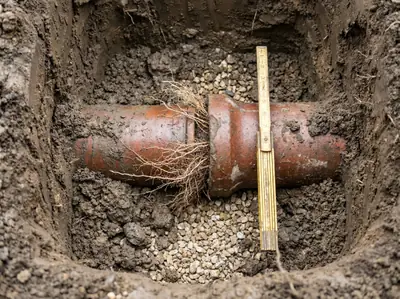
It fails at the joints, not in the middle of the pipe. Every joint is a seam a root can find, and a mature boulevard tree has had decades to find all of them. Joints also offset as the ground moves, leaving a lip that catches everything passing over it.
What the camera shows
Root masses entering at regular intervals, matching the joint spacing. Offset joints showing a step in the pipe wall. Often a long run of sound pipe between two bad joints.
Can it be lined? Yes Can it be burst? Yes

Clay is the best trenchless host material there is: it is round, it holds its shape, and it breaks cleanly. It takes a liner well and it bursts predictably, so the camera decides which is cheaper rather than which is possible.
Cast iron

Also called CI, iron soil pipe

Sanitary lateral

Heavy iron pipe, typically used for the drain inside and under the building and sometimes out to the property line. Strong in compression and genuinely durable — the problem is chemistry, not strength.

When it is commonly found
common in mid-century construction, and still found in buildings of that period today
Service life
commonly quoted at fifty to a hundred years, but corrosion rate depends heavily on what has been running through it
How it fails
It corrodes from the inside out. Scale builds on the pipe wall and narrows the bore until a line that was four inches is effectively passing two, and eventually the bottom of the pipe — where the flow sits — corrodes through entirely while the crown still looks fine.
What the camera shows
A rough, tuberculated interior that snags the camera. Channelling along the invert where the bottom has worn away. The pipe can look intact from above and be gone underneath.
Can it be lined? Conditional Can it be burst? Yes

Lining works only if enough sound wall remains to carry the liner while it cures, and heavy channelling can mean there is not. Descaling first is often required, and sometimes descaling is what reveals the pipe is past lining.

Orangeburg

Also called bituminous fibre pipe, fibre conduit, tar paper pipe

Sanitary lateral

Wood pulp bound with coal tar pitch — cardboard, functionally. It was cheap, light and quick to install, and it was never going to last as long as the house.

When it is commonly found
commonly installed from roughly the 1940s into the 1970s
Service life
frequently reaching end of life within thirty to fifty years, and any that remains in service is well past the age it was designed for
How it fails
It deforms before it breaks. The pipe goes oval under soil load, then blisters and delaminates from the inside, then collapses. A line can lose most of its cross-section while still technically being a pipe.
What the camera shows
An unmistakable oval or egg-shaped bore. Blistering and peeling of the inner wall. Often the camera simply cannot pass.
Can it be lined? No Can it be burst? Yes

A liner needs a host that holds its shape while the resin cures, and deformed Orangeburg does not. Finding Orangeburg on camera effectively makes the decision: burst it or dig it, and bursting is almost always cheaper.

Concrete

Also called non-reinforced concrete pipe, NRCP

Sanitary lateral

Cast concrete pipe in jointed sections. Strong, heavy, and generally reliable in the ground.

When it is commonly found
used across much of the twentieth century, more often on larger-diameter runs than on house laterals
Service life
typically long-lived, though crown degradation can run well ahead of the pipe’s apparent age where ventilation has been poor
How it fails
Sanitary gas attacks it. Hydrogen sulfide above the flow line converts to acid on the damp pipe crown and eats the cement matrix, so the top of the pipe degrades while the submerged bottom stays sound. Joints also offset and admit roots.
What the camera shows
Exposed aggregate on the crown where the paste has gone. A visibly rough upper wall against a smoother invert.
Can it be lined? Yes Can it be burst? Conditional

Lines well. Bursting concrete is harder than bursting clay — it is tougher and less predictable about how it fragments — so it is assessed case by case rather than assumed.

ABS

Also called black plastic drain pipe

Sanitary lateral

Black rigid plastic in long solvent-welded lengths. Far fewer joints than clay, and the joints it has are chemically welded rather than gasketed.

When it is commonly found
common in Canadian construction from roughly the 1970s onward
Service life
expected to outlast most of the houses it was installed under, absent physical damage
How it fails
The material rarely fails on its own. What fails is the installation: a belly where bedding settled and now holds standing water, a crushed section where something was driven over it, or a joint that was cold-welded badly on the day.
What the camera shows
Standing water sitting in a low spot with the pipe wall sound either side of it. Clean pipe with one specific defect, rather than a line failing all over.
Can it be lined? Conditional Can it be burst? Yes

A bellied ABS line is the clearest case there is of lining being the wrong answer: a liner follows the host, so it will faithfully reproduce the belly and the water will still sit in the same low spot afterwards. That is a bursting or a dig job.

PVC

Also called white plastic drain pipe, SDR 35

Sanitary lateral · Water service

Rigid plastic in long lengths with gasketed or solvent-welded joints. Smooth bore, very few joints, chemically inert.

When it is commonly found
common from roughly the 1970s and 1980s onward, and the default in newer construction
Service life
expected to outlast most of the houses it was installed under, absent physical damage
How it fails
Same story as ABS — the pipe outlives the problem. Bellies from poor bedding, crushing from heavy equipment over a shallow run, and root intrusion at a gasketed joint that was not seated properly.
What the camera shows
Long clean runs. A defect in PVC is usually one identifiable event at one location, not a line-wide condition.
Can it be lined? Conditional Can it be burst? Yes

Where the camera shows PVC and a single blockage, the answer is usually a cleaning rather than a replacement. Plastic of this age has not run out of service life, and what has gone wrong is almost always one identifiable event rather than the pipe giving up.

HDPE

Also called poly pipe, high-density polyethylene

Sanitary lateral · Water service

Flexible black plastic joined by heat fusion, which makes the joint as strong as the pipe. It arrives on a reel and goes in as one continuous length.

When it is commonly found
the modern replacement material, and what we pull in when we burst a line
Service life
specified for a service life measured in generations rather than decades, which is the reason bursting is worth doing at all
How it fails
Nothing age-related in ordinary service. It does not corrode, it does not scale, and because a pulled-in run has no joints in the ground there is nothing for a root to enter.
What the camera shows
A continuous smooth bore with no joints between the pits.
Can it be lined? No Can it be burst? No

This is the output of a trenchless replacement, not an input to one. Its jointlessness is the entire point: the failure mode that killed the old clay line does not exist in the new one.

Material and era are trade generalisations, not a record of what is under any particular property. What is actually in the ground at an address is settled by a camera, not by the year the house was built.

How the camera finding decides between bursting and lining →

Two small access pits for a trenchless sewer repair at either end of a lawn, the driveway and tree between them untouched.
Two access pits and undisturbed ground between them

People also ask

What is a trenchless sewer line?

There is no such thing — trenchless is a way of getting at a pipe, not a kind of pipe. It means replacing or relining a sewer lateral from two pits instead of a trench along its whole length. The ground between them is never opened. Two pits still get dug: trenchless is not excavation-free.

Questions about trenchless sewer

The ones that come up on this work specifically. The general questions are answered on the FAQ page.

How do you decide between lining and bursting?
The camera decides it, and it decides on two things. What the pipe is made of, and whether it still holds its shape. A liner cures against the host pipe, so the host has to be there and has to stay round — that rules out a collapsed line and rules out Orangeburg, which deforms before it breaks. Where both methods are available, and on sound clay they usually are, the choice comes down to the pattern of damage and what is on the surface above the run. Neither of them can move a pipe or correct its grade.
Do you have to dig at all?
Yes, and anyone telling you otherwise is selling something. A trenchless replacement needs a pit at each end of the run, typically one near the house and one out at the connection. They are real excavations, they need locates before anything goes in, and they need backfilling and reinstating afterwards. The point of the method is not that no ground is opened. It is that the ground between the pits — the driveway, the patio, the tree, the thirty years of landscaping — is left where it is. A lining job can sometimes be reached through an existing cleanout with little or no excavation at all.
What if the camera shows the pipe is fine?
Then we tell you it is fine, clean what needs cleaning, and leave. That is a dull answer and in the newer communities it is frequently the right one — plastic pipe goes in as long runs with very few joints and has no wear-out mechanism, so a backup out there is usually a blockage rather than a failure. We would rather give that answer than sell past it. A company that never tells anyone their line is sound should not be believed on the days it recommends a replacement.
How long is the line out of service?
Long enough that you should plan for it, and we are not going to put a number on a web page. It depends on the method, the length of the run, the access and what the pipe turns out to be once it is cleaned — and a duration quoted before any of that is known is a guess with a schedule attached. What we will do is commit to a window once we have the footage and the site, and tell you what is usable in the house while the work is happening.

Also asked on every job

Answered in full, once, on the page each one belongs to — rather than repeated on every page of this site.

Every question we are asked, and where each is answered

Where we work

The same work, and a different likely answer, depending on when the ground under the property was built out.

Calgary and its quadrants

Round-ups of the range of development eras in each quarter of the city, and therefore of what is most likely in the ground.

Outside Calgary

Separate municipalities, each with its own authority having jurisdiction and a mostly newer buried stock.

We camera the line before we quote it

No method gets named on the phone. Tell us what the line is doing and how old the house is, and the next step is footage you keep.