Calgary and surrounding municipalities

Water Line Replacement

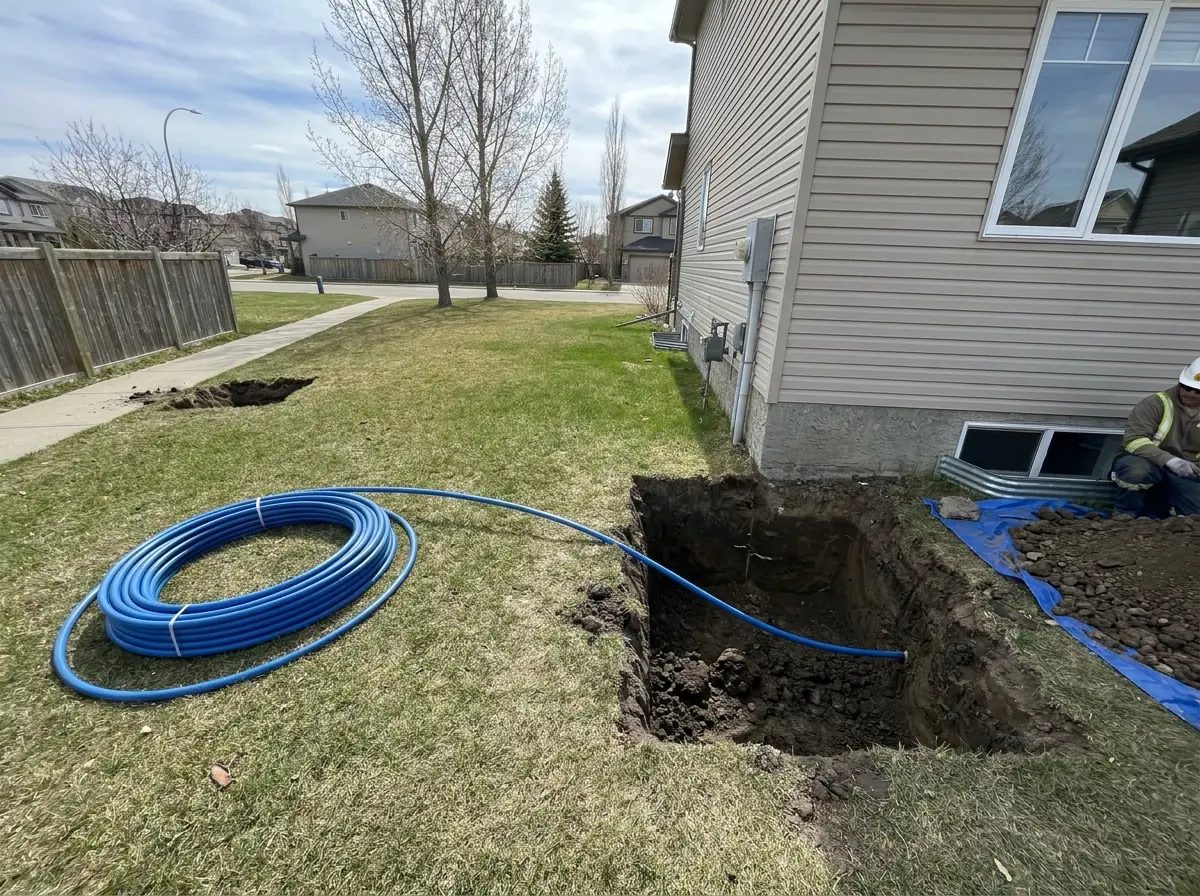
The water service between the curb stop and a Calgary house, replaced by pulling new pipe through instead of trenching the front yard.

A water service is one pipe carrying everything the house uses, and it is the only buried line on a property with nothing redundant about it. When a sanitary lateral fails you find out immediately and unpleasantly. When a water service fails it usually does so quietly, and people arrive here from one of two directions: flow that has been getting worse for so long the household stopped noticing, or a second leak on a line that was already dug up and repaired once.

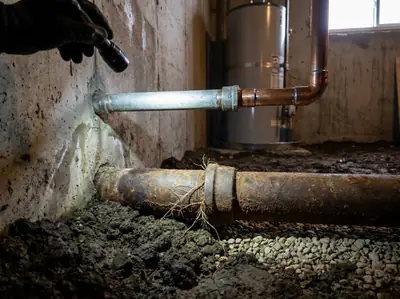
Which of those you have depends almost entirely on what the service is made of. Galvanized steel is common in older housing stock, largely superseded by copper and then by plastics. Once the zinc is gone the steel corrodes and the bore fills with rust scale. Pressure drops progressively across the whole house, and the threads — where the wall is thinnest — are where it finally leaks. That is a whole-house symptom rather than a single-fixture one, and it arrives on a timescale slow enough that people adapt to it instead of reporting it. Service life on this material is commonly quoted at several decades, though flow is usually unacceptable well before the pipe actually leaks — which is why a galvanized service is normally replaced on the strength of how the house behaves, not on the strength of anything you can see.

Copper fails the other way round. Pinhole leaks. Copper corrodes from the outside where soil chemistry is aggressive to it, and from the inside where water chemistry is. A service can leak for a long time underground before anything shows at the surface. The reason one pinhole matters more than it looks is that the rest of the run sits in the same soil, at the same age, with the same water through it — one leak in a long copper service is a data point about the whole line, not only about the spot that gave way. When a second one turns up in the same run, the line has told you what it is doing.

One thing to settle before anything else: a water service is not lined. Lining is a sewer method. Water services are not lined. A failed copper service is pulled out and replaced, and because it is small-diameter and jointless it pulls through beautifully — this is the cleanest trenchless job there is. If someone has offered to line your water service, ask them to explain it, because it is not a thing that is done.
How water line replacement runs, step by step

  1. Step 1

    Confirm it is the service

    Pressure and flow behaviour, and where the problem shows, separate a failing buried service from a problem inside the house.

  2. Step 2

    Identify the material

    Copper, galvanized or lead — each one fails differently and each one changes whether this is urgent or merely eventual.

  3. Step 3

    Locates and pits

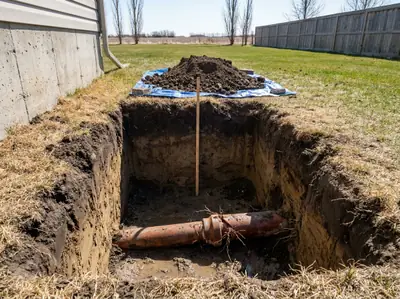
    Alberta One-Call locates, then a pit at the house and a pit at the connection. The lawn between them stays where it is.

  4. Step 4

    Pull the new line

    New pipe is drawn through in one continuous length, so there is no joint buried anywhere along the run to leak later.

  5. Step 5

    Tie in and pressure test

    Connected at both ends, tested, and the pits backfilled and reinstated.

What the day actually looks like

Locates come first and they are not a formality. Alberta One-Call marks what else is buried along the run, and a front yard can carry gas, power, telecommunications and irrigation crossing the path of the service at depths nobody recorded. Only once that is marked on the ground do the two pits get dug — one where the service enters the house, one at the far end near the connection. Everything between them stays exactly where it is, which on a front yard normally means the driveway, the walk, the sod and whatever is rooted in it.

What surprises people is how much of the day is spent apparently doing nothing. The new HDPE arrives on a reel and is prepared as one continuous length before anything moves, because a run with no joint buried anywhere along it has nothing left to leak later. That jointlessness is the entire return on the job: this material is specified for a service life measured in generations rather than decades, which is the reason bursting is worth doing at all. Then the water goes off, the pull itself takes a fraction of the time the pits took, and the remainder of the day is tie-ins, pressure testing, backfill and reinstatement. Plan around being without water for part of a working day rather than around the noise, which is modest next to a sewer job.

What decides the scope

Four things set the specification. The length from the connection to the house, which on a deep lot with a long front setback is the largest single quantity in the job. The depth, which on a water service is governed by frost rather than by grade — a sanitary lateral has to be set so it falls to the main, whereas a water line only has to stay below frost and take the cleanest path available. What the existing service is made of, because galvanized steel and copper do not behave the same way under a pull. And what is buried beside the line, which is a limitation of the method rather than a detail of the property: It displaces soil sideways. Where another utility runs close and parallel, that has to be established by locates before anything is pulled, and sometimes the answer is that it cannot be done safely.

The two ends decide as much as the run between them. What the shutoff at the property line does when it is actually turned — whether it holds, whether it has been turned in this decade — can change the shape of the job on the morning of it. So can the question of which section of the run between the main and the house is whose responsibility. That is not something to take from any website, this one included: confirm with the City who owns the section that failed before anyone puts a scope against it.

What people get wrong about this

Trenchless is not hole-free

Two pits still have to be dug. This is trenchless, not excavation-free, and the pits are real holes in real ground. What trenchless buys is that the holes are at the two ends instead of a trench running the length of the yard, and that the driveway, the walk and the mature tree between them are never opened.

A new service does not fix old pipe inside the house

If the supply piping in the walls is also at the end of its life, replacing the buried service restores pressure as far as the point where it enters the building and no further. From the tap the symptom is identical. Establish which one you have before the job rather than after — this is the most common reason a replacement disappoints the person who paid for it.

Low pressure is not automatically the service

A seized or partly closed shutoff, a failing pressure-reducing valve, a blocked screen at a fixture, or a softener that is overdue all produce the same complaint. A service that has genuinely lost its bore shows a pattern: every fixture, every time, worsening across years. A problem that appeared last month usually has a different cause, and it is usually a cheaper one.

Ask what happens to the old pipe

On a pull-through replacement the old service is not taken out of the ground; the new line takes its path. For copper and for steel that is a non-issue. Where the old line is lead it is not a neutral detail at all, and that case has its own page and its own scope conversation for exactly that reason.

When this is the wrong answer

If you have one leak and sound pipe either side of it, this is the wrong page — that is a repair, and the honest comparison between repairing and replacing is written there rather than here, because that is where the person with a leak actually lands. If the complaint is one fixture rather than the whole house, the problem is almost certainly inside the building and no buried work will touch it. And trenchless is not automatically the cheaper route. Our own method notes put open-cut as the right answer for this: A line that has to change grade or route, a collapse in a spot that cannot be reached from either end, a run too shallow or too congested to burst safely, and — often — a short run under ground with nothing on it, where digging is simply cheaper than mobilising trenchless equipment. We will say so when that is what the site shows. Mobilising equipment to save a lawn that was going to be dug up anyway is a cost with nothing on the other side of it.

What a water service is made of, and what that changes

Every decision on this work turns on the material in the ground and how it fails. These are the ones commonly found under Calgary properties. Which one is under yours is settled by a camera, not by the year on the title.

PVC

Also called white plastic drain pipe, SDR 35

Sanitary lateral · Water service

Rigid plastic in long lengths with gasketed or solvent-welded joints. Smooth bore, very few joints, chemically inert.

When it is commonly found
common from roughly the 1970s and 1980s onward, and the default in newer construction
Service life
expected to outlast most of the houses it was installed under, absent physical damage
How it fails
Same story as ABS — the pipe outlives the problem. Bellies from poor bedding, crushing from heavy equipment over a shallow run, and root intrusion at a gasketed joint that was not seated properly.
What the camera shows
Long clean runs. A defect in PVC is usually one identifiable event at one location, not a line-wide condition.
Can it be lined? Conditional Can it be burst? Yes

Where the camera shows PVC and a single blockage, the answer is usually a cleaning rather than a replacement. Plastic of this age has not run out of service life, and what has gone wrong is almost always one identifiable event rather than the pipe giving up.

Copper

Also called Type K copper, soft copper service

Water service

Soft copper tubing, usually run in one continuous coil from the curb stop to the house so there are no buried joints at all.

When it is commonly found
the common water service material through much of the later twentieth century and still installed today
Service life
commonly decades of service, with soil conditions along the run mattering more than age
How it fails
Pinhole leaks. Copper corrodes from the outside where soil chemistry is aggressive to it, and from the inside where water chemistry is. A service can leak for a long time underground before anything shows at the surface.
What the camera shows
Not a camera job — water services are too small. Leaks are found by acoustic detection, pressure test and correlation, not by looking down the pipe.
Can it be lined? No Can it be burst? Yes

Water services are not lined. A failed copper service is pulled out and replaced, and because it is small-diameter and jointless it pulls through beautifully — this is the cleanest trenchless job there is.

Lead

Also called lead service line, lead goose-neck

Water service

Soft grey metal pipe, dull rather than shiny, and soft enough to be marked with a coin. Some properties have a full lead service; others have only a short lead connector at the main.

When it is commonly found
found in some of the oldest housing stock; long superseded, but legacy sections remain in service in many older North American cities
Service life
structurally long-lived, which is precisely the problem: it does not fail in a way that forces its own replacement
How it fails
The concern is not structural. Lead pipe can remain watertight indefinitely and still be a reason to replace it, because the pipe itself is the contaminant.
What the camera shows
Identified by exposing and examining the pipe where it enters the building, and by testing — not by any camera.
Can it be lined? No Can it be burst? Yes

Replaced, never repaired and never lined. A partial replacement that leaves lead in the ground is widely considered worse than leaving it alone, so the scope question — full run or not — is settled before work starts.

Galvanized steel

Also called galvanized iron, GI pipe

Water service

Steel pipe with a zinc coating, threaded at the joints. The coating is what protects it, and the coating is finite.

When it is commonly found
common in older housing stock, largely superseded by copper and then by plastics
Service life
commonly quoted at several decades, though flow is usually unacceptable well before the pipe actually leaks
How it fails
Once the zinc is gone the steel corrodes and the bore fills with rust scale. Pressure drops progressively across the whole house, and the threads — where the wall is thinnest — are where it finally leaks.
What the camera shows
Diagnosed by pressure and flow behaviour and by cutting a section, not by camera.
Can it be lined? No Can it be burst? Yes

Replaced rather than repaired. A galvanized service that has lost its bore cannot be restored — cleaning it removes what is left of the protective layer.

HDPE

Also called poly pipe, high-density polyethylene

Sanitary lateral · Water service

Flexible black plastic joined by heat fusion, which makes the joint as strong as the pipe. It arrives on a reel and goes in as one continuous length.

When it is commonly found
the modern replacement material, and what we pull in when we burst a line
Service life
specified for a service life measured in generations rather than decades, which is the reason bursting is worth doing at all
How it fails
Nothing age-related in ordinary service. It does not corrode, it does not scale, and because a pulled-in run has no joints in the ground there is nothing for a root to enter.
What the camera shows
A continuous smooth bore with no joints between the pits.
Can it be lined? No Can it be burst? No

This is the output of a trenchless replacement, not an input to one. Its jointlessness is the entire point: the failure mode that killed the old clay line does not exist in the new one.

Material and era are trade generalisations, not a record of what is under any particular property. What is actually in the ground at an address is settled by a camera, not by the year the house was built.

How the camera finding decides between bursting and lining →

Trenchless water line replacement: new blue water service pipe drawn into a pit beside a house, the front lawn untouched.
A new water service drawn through under the lawn

Questions about water line replacement

The ones that come up on this work specifically. The general questions are answered on the FAQ page.

Does the whole yard have to be trenched?
Usually not. A water service is small-diameter and normally runs as one continuous length with no buried joints, which makes it the cleanest trenchless job there is — a new line pulls through from a small pit at each end and the ground between them is left alone. Where it does get trenched is where trenching is genuinely the better job: a short, shallow run under bare lawn, or a line that has to be re-routed rather than replaced along the same path. We will tell you which one yours is after we have looked at the run, not before.
What goes in as the new line?
HDPE, joined by heat fusion, which makes the joint as strong as the pipe. It arrives on a reel and goes in as one continuous length, so between the pits there are no joints in the ground at all. It does not corrode, it does not scale, and there is nothing for a root to enter. On a service that failed because copper pinholed or galvanized steel lost its bore, that is the whole point: the failure mode that ended the old line does not exist in the new one.
Who decides how much of the line gets replaced?
Partly you, and partly the authority that supplies your water — because a buried service runs from the municipal connection to the building and how that length is divided is theirs to state, not ours. We are not going to put their business on a page. Confirm with the City who owns the section that failed before you commit to a scope, and get that answer from them. It matters more than it sounds: it decides whose decision the work is and where a replacement can reasonably stop.
Will the house be without water?
For part of it, yes. The service has to be cut over from the old line to the new one and there is no version of that with water running. We will not publish a duration — it depends on the length, the access, the ground and what is found at each end, and a figure on a page would be a guess. What we will do is tell you the window once the site has been seen, and tell you when it starts on the day rather than leaving you to work it out from the noise.

Where we work

The same work, and a different likely answer, depending on when the ground under the property was built out.

Calgary and its quadrants

Round-ups of the range of development eras in each quarter of the city, and therefore of what is most likely in the ground.

Outside Calgary

Separate municipalities, each with its own authority having jurisdiction and a mostly newer buried stock.

We camera the line before we quote it

No method gets named on the phone. Tell us what the line is doing and how old the house is, and the next step is footage you keep.