Lead water service lines: how to find out what you actually have
Every other pipe on a property tells you when it is finished. It leaks, or it blocks, or the pressure drops, and something forces the conversation.
Lead does not do that. Our material reference is blunt about why:
The concern is not structural. Lead pipe can remain watertight indefinitely and still be a reason to replace it, because the pipe itself is the contaminant.
And:
structurally long-lived, which is precisely the problem: it does not fail in a way that forces its own replacement
So there is no event to wait for. If you want to know whether you have it, you have to go and look — and this post is about how to do that properly, because the identification is genuinely easy to get wrong in both directions.
What this post will not do is tell you what is in your ground. We have no basis for a claim about how common lead services are at any particular address or in any particular part of this city, and inventing one would be worse than useless. What follows is how to establish it for your own property.
What lead pipe is
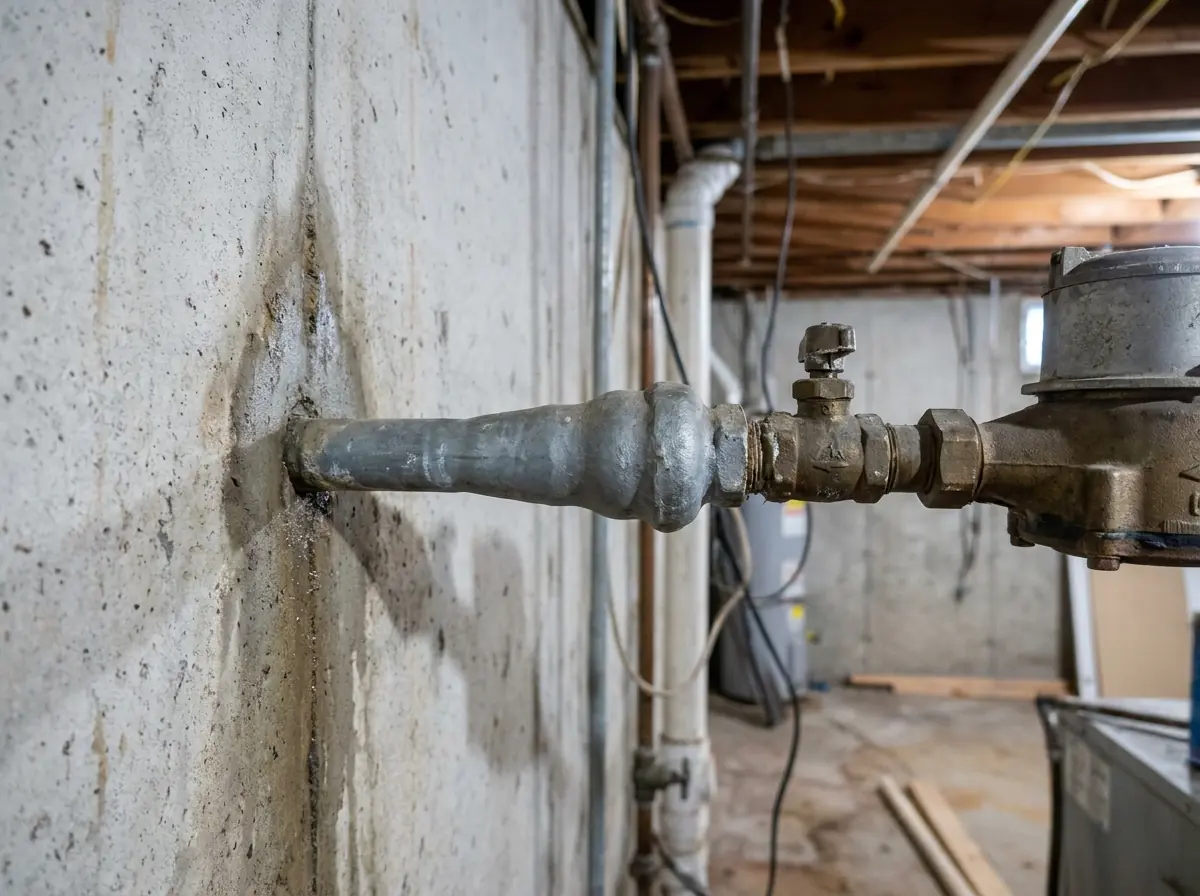
Soft grey metal pipe, dull rather than shiny, and soft enough to be marked with a coin. Some properties have a full lead service; others have only a short lead connector at the main.
That second sentence matters and is frequently missed. A property can have copper running most of the way and a short lead section — sometimes called a goose-neck — where the service meets the main. Finding copper at the house does not, on its own, settle the question.
As for when: it is
found in some of the oldest housing stock; long superseded, but legacy sections remain in service in many older North American cities
That is a trade generalisation about housing stock, not a record of what was installed anywhere in particular.
Where to look
Where the water service enters the building, ahead of the meter and ahead of the main shut-off. That is usually a basement wall or a mechanical room, and it is the one length of the service that is visible without digging.
Find the pipe coming through the wall or the floor and follow it to the shut-off valve. That section — between where it enters and where the valve is — is what you are looking at.
Clean a small patch with a cloth or fine abrasive first. Decades of surface oxidation and paint make every metal pipe look like every other metal pipe.
The three tests
Do all three. Any one of them on its own produces confident wrong answers.
1. The magnet
Hold a fridge magnet against the cleaned pipe.
- It sticks firmly: the pipe is steel. Almost certainly galvanized steel, which is a completely different material with completely different problems — it corrodes, the bore fills with rust scale, and pressure across the whole house drops. Not lead.
- It does not stick: lead, copper or plastic. Keep going.
2. The scratch
Draw a coin or a key firmly across the cleaned patch. Not a knife — you are testing softness, not cutting into a live service.
- A bright silver streak appears easily, and the metal marks under light pressure: that is the classic lead result. Lead is soft, and what is underneath the dull grey surface is shiny.
- The scratch shows copper-orange: copper.
- It barely marks at all: steel, and the magnet should have told you that already.
3. The look of the joints
Lead is worked rather than threaded. Connections are often bulbous, rounded and hand-formed — a swelling at the joint rather than a coupling. Galvanized steel is threaded, with visible machined couplings. Copper is soldered, with slim neat joints.
A rounded, lumpy connection where a modern pipe would have a fitting is a strong signal.
What none of that settles
Three things, and they are the reason this cannot be finished from inside the basement.
The rest of the run. You have examined the piece that comes through the wall. The service continues underground to the connection at the street, and the visible section is not proof of the buried one. Properties have been partly replaced before, in either direction.
The section nearest the main. A short lead connector at the main end is precisely the part you cannot see from inside.
Lead solder is a different question. Lead-bearing solder on copper joints is not a lead service line. It is a separate matter, it is about interior plumbing, and confusing the two produces both false alarms and false reassurance.
Things people mistake for lead
Galvanized steel. The single most common misidentification, because it is grey, dull and old-looking. The magnet separates them instantly.
Painted copper. Decades of paint on a basement pipe hides the colour. Clean a patch before deciding anything.
Grey plastic. Lightweight, warm to the touch, and not metal. It will not mark like lead and no magnet will stick.
How you would actually confirm it
The identification method in our own file is not clever:
Identified by exposing and examining the pipe where it enters the building, and by testing — not by any camera.
Not by any camera. Water services are small-diameter; there is no camera survey for one. Anyone offering to camera a water service to check for lead is describing something that does not exist.
Two routes give you a real answer:
Test the water. Testing is the direct route, it does not depend on anyone’s eyesight or on what is buried, and it is not something a contractor should be interpreting for you. Your water utility is the right first call about what testing is available and how it is done for your address. An accredited laboratory is the other route. Take the result from whoever ran it, not from a plumber’s opinion about the pipe.
Have the buried section established. That means exposing it, which is a real if small job, or asking the authority that supplies your water what its records show about the service to your address. Which brings us to the part that gets assumed and should not be.
Who owns which part of the line
Ask the City.
A buried service runs from the municipal connection to the building, and how that length is divided — which section belongs to the property and which does not — is the water authority’s to state, not a contractor’s. It is load-bearing here, because it decides whose decision a replacement is and what scope you are even discussing.
We are not going to state it on their behalf on a web page. Confirm with the City who owns the section in question before you commit to anything, and get the answer from them.
If it is lead
The method is settled and there is no debate in it:
Replaced, never repaired and never lined. A partial replacement that leaves lead in the ground is widely considered worse than leaving it alone, so the scope question — full run or not — is settled before work starts.
Read the middle clause carefully. A partial replacement that leaves lead in the ground is widely considered worse than leaving it alone. That is why the ownership question above has to be answered first rather than during: a replacement that stops at a boundary and leaves a lead section beyond it is the scenario that advice exists to prevent.
The mechanics of the replacement itself are the most straightforward work in this trade. A water service is small-diameter and normally jointless, and a new fused HDPE line pulls through cleanly from two small pits rather than a trench down the length of the yard. The material that goes in is specified for a service life measured in generations.
The hard part is never the pipe. It is settling the scope honestly before anyone starts.
The short version
Lead will not force the conversation, so you have to start it. Clean a patch where the service enters the building, use a magnet and a coin, and look at how the joints are formed. Then remember that the visible section is not the whole service.
If the tests point at lead, the next calls are the water authority — about testing, and about who owns which section — rather than a contractor. When the scope is clear, the replacement is a small job with a permanent answer.
Lead pipe replacement · Water line replacement · What the materials are
Want the line looked at?
Nothing here gets quoted off a description. The camera goes down first, you watch the screen, and you keep the footage — including on the jobs where the answer turns out to be that nothing needs replacing.