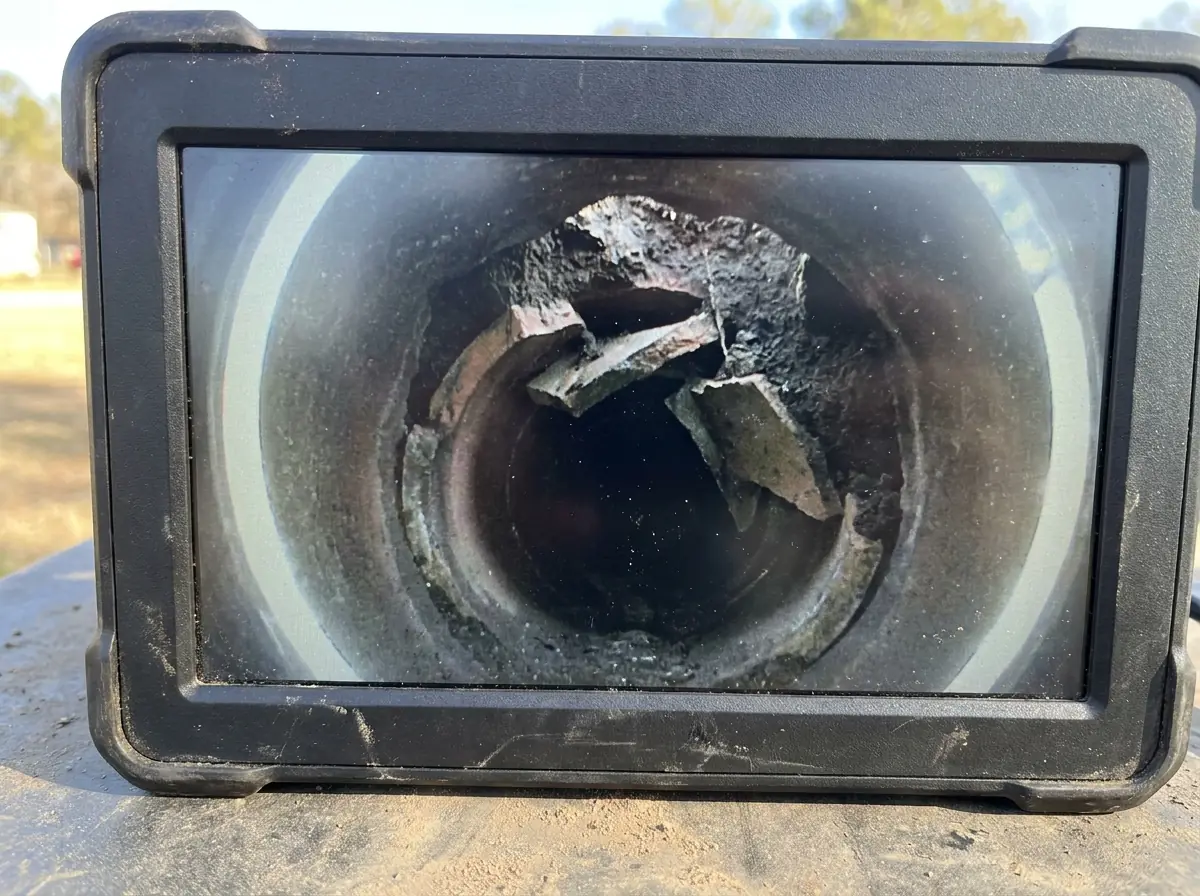
How to tell if your sewer line is collapsed
Here is the uncomfortable part of this question, stated first so nobody wastes their afternoon: you cannot tell from inside the house.
A collapsed line and a blocked line produce the same symptoms. Both stop the water leaving. Both back up at the lowest fixture. Both make the same noises. The difference between them is the difference between a visit and a project, and the only thing that separates them is footage.
What this post can do is tell you which symptoms mean main line rather than fixture, what shifts the odds toward a structural failure, and what the phrase “collapsed” actually means — because it is used loosely, and the loose version has sold a lot of replacements.
What “collapsed” actually means
In the trade it means the pipe has lost its shape and its bore. Not cracked. Not blocked. Deformed to the point that the passage through it is gone or nearly gone, and the pipe can no longer be relied on to hold itself open.
That matters because it eliminates options rather than adding them. A cured-in-place liner needs a host pipe that is still there and still holding its shape — the liner cures against the old pipe, so the old pipe is the mould. Our method file states it without qualification:
It cannot fix a collapsed pipe. There has to be a pipe left to line.
So a genuine collapse means bursting or digging. Which is exactly why the word gets used loosely by people quoting one of those two things.
Symptoms that say “main line”, not “one fixture”
None of these say collapse. All of them say the problem is in the line that serves the whole house rather than in one trap under one sink.
- Every drain in the house is slow, not one. A single slow sink is a fixture problem. The whole house slowing at once is downstream of everything.
- The lowest fixture is the one that backs up. Basement floor drain, basement toilet, a laundry standpipe. Water takes the first exit it can find, and gravity picks that exit for it.
- Using one fixture affects another. Flushing a toilet and hearing the shower drain gurgle. A washing machine discharging and the floor drain bubbling. That is air being pushed past an obstruction, and it means the two fixtures share a problem further down.
- Gurgling from a floor drain when nothing is running. Same mechanism, arriving unprompted.
- It comes back. A blockage cleared and returning within weeks is a symptom in its own right. Something is still there.
If none of those describe you and one fixture is slow, stop reading. That is not a sewer line.
What shifts the odds toward structural failure
Still not a diagnosis. These are the things that would make an experienced operator expect to find something structural before the camera goes in.
The age and the material. Clay fails at the joints. Cast iron fails through the bottom of the pipe. Orangeburg deforms and collapses, and any of it still in service is decades past what it was designed for. Plastic in a newer community usually does not fail at all — it gets blocked. The material differences are set out here.
A history of repeat blockages at the same distance. If two different companies have both found something roughly the same distance out, that is a location rather than an event.
A cable that stops dead. A snake meeting soft resistance and pushing through is often a blockage. A cable meeting something hard that will not pass, in the same place, every time, is a different signal — though it can also be an offset joint, a root mass, or the cable finding the wrong way at a junction. It is a reason to look, not a conclusion.
Ground that has changed above the line. A soft spot, a depression, or grass that is greener along a strip of the yard. Water escaping a failed line changes the ground above it. This one is genuinely suggestive and it is worth walking your yard for.
Sewage smell outdoors near the run. Same reason.
Something heavy went over it. A shallow run under a spot where a truck, a skid steer or a delivery got parked during a renovation. Crushing is a real failure mode in plastic and it is usually one event with a date attached, if anybody remembers it.
What does not tell you anything
Worth listing, because these get used as evidence.
- The age of the house. Clay is often still sound at a hundred years. Age alone is not a reason to replace anything.
- How bad the backup was. Severity is about where the water had to go, not about what is wrong down the line.
- What the neighbour had done. Same street, same era, different tree, different bedding, different history. Two houses side by side routinely need different work.
- A verbal diagnosis over the phone. Nobody can see your pipe from a phone call, including us.
The only thing that settles it
A camera survey. A camera head on a push rod, run the length of the line, with a sonde that lets the position of anything found be located from the surface.
It establishes four things, and those four things are the entire decision:
- What the pipe is made of. Which rules methods in and out before anything else is discussed.
- Whether it still holds its shape. Round pipe can host a liner. Oval, deformed or collapsed pipe cannot.
- Where the defects are, and how many. One place, or every joint for the length of the run.
- Whether the pipe is even the problem. A blockage in sound plastic is a cleaning.
One practical note about surveying a line that is currently blocked: a camera cannot see through standing water and debris. On a line that is backed up, the blockage usually has to be cleared enough for the camera to pass before the survey means anything — which is why the honest sequence on an active backup is often clear it, then look at it, rather than one or the other.
What the footage actually shows you goes through this frame by frame.
If it is a collapse
Then the options narrow, and they narrow in a way that is easier to think about than it sounds.
Lining is out — there is no host to line against. What is left is bursting, which fractures the old line outward and pulls a new fused HDPE pipe through in the same pass, or digging it up and re-laying it.
Bursting needs a path the head can follow, and a badly collapsed section can be exactly what stops one. It also needs established clearance from other buried services along the run, because the method displaces soil sideways — and sometimes locates come back saying it cannot be done safely.
Where the collapse sits in the middle of a run that cannot be reached from either end, a dig is frequently the answer, and a trenchless company that will not say so is not worth listening to on anything else.
If it is not
Which, in the newer half of this city, it usually is not.
A blocked plastic line is a cleaning. Hydro jetting cleans the pipe wall properly rather than punching a hole through what is sitting in it, and on a structurally sound line it is the right tool.
On a line that is already failing, it is not — high-pressure water can finish a badly deteriorated pipe, which is the other reason the camera goes first.
We camera the line before we quote it. If the footage shows sound pipe and one blockage, that is what we will tell you, and it is a dull answer that is right more often than the interesting one.
Book a camera survey · Sewer backups · Something backing up right now
Want the line looked at?
Nothing here gets quoted off a description. The camera goes down first, you watch the screen, and you keep the footage — including on the jobs where the answer turns out to be that nothing needs replacing.