What are the disadvantages of CIPP lining?
We line pipe. This post lists the reasons not to, and it lists them without softening, because a method described only by the company selling it always reads as the best one available — and the moment a homeowner reads two such pages back to back, neither is believed.
So here are the limitations, as they are recorded in our own method file, unedited:
- It cannot fix a collapsed pipe. There has to be a pipe left to line.
- It reproduces the geometry it is given. A bellied line stays bellied, and water will still stand in the same low spot afterwards.
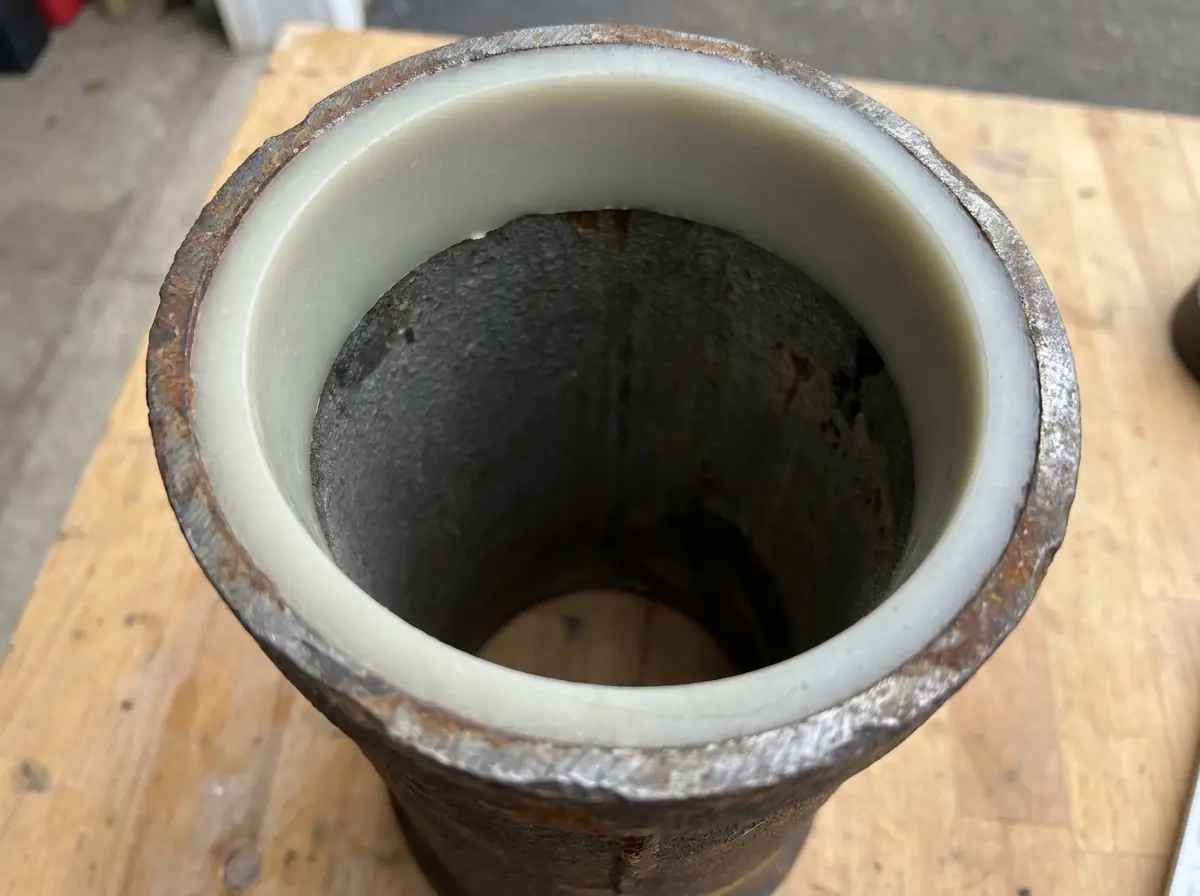
- The liner takes up wall thickness, so the finished bore is slightly smaller than the original — normally irrelevant, occasionally not.
- Every branch connection along the lined section is covered by the liner and has to be reinstated afterwards, which is a separate operation.
- Not used on water services. Lining is a sewer method.
Now the part that matters: what each one means for your line.
1. There has to be a pipe left to line
A cured-in-place liner is not structural on its own until it has cured, and it cures against the host. The old pipe holds the shape while the resin goes off. Take away the host and you have nothing for the liner to form against.
This is the reason a collapsed line is never a lining job. It is also the reason Orangeburg is never a lining job — that material deforms before it breaks, and by the time the camera finds it, it is usually oval. Lining oval pipe produces a liner that is oval.
If the camera cannot pass, that is not a scheduling problem. It is the answer.
2. A bellied line stays bellied
This is the one that costs people money, because a belly does not look like a defect on a camera the way a crack does. It looks like water.
A belly is a low spot where the bedding under the pipe settled. Flow slows there, solids drop out, and the line blocks repeatedly at the same place. The pipe itself can be perfectly sound.
A liner follows the pipe. Put one through a bellied run and you have a brand new jointless pipe with the old pipe’s low spot moulded into it, and the water will stand in exactly the same place. That is a bursting job or a dig — something that can re-lay the pipe on proper bedding at proper grade.
If somebody has recommended lining and the footage shows standing water, ask them about this specifically, and get the answer in writing.
3. The bore gets slightly smaller
The liner has wall thickness, and that thickness comes out of the inside of the pipe. On a normal residential lateral this is almost never the deciding factor — a smooth jointless bore usually carries flow better than the scaled, rooty, offset pipe it replaced, even at a marginally smaller diameter.
“Almost never” is not “never”. On a line that is already undersized for what it serves, or on a commercial run designed close to its capacity, it is a calculation rather than an assumption. It is worth one question at the quote.
4. Every branch connection has to be reinstated
The liner is continuous. It passes straight over the openings where anything else joins the line — a branch serving a second building, a garage drain, a secondary stack. Those openings are sealed by the liner and have to be reopened afterwards.
That is a real, separate operation with its own equipment and its own time, and it should appear on your quote as its own item. If your line has three branches along the lined section and the quote mentions none of them, the quote is incomplete.
This is a large part of why commercial and multi-residential lining is a different conversation from a single-family lateral. On larger buildings the branch count is the scope.
5. Lining is a sewer method
Water services are not lined. A failed water line is repaired at the defect or replaced entirely. Nobody lines a lead service and nobody lines a pinholed copper one — a lead line in particular is replaced precisely because the pipe itself is the problem, and a coating inside it is not a scope anyone should be offering you.
If a quote offers to line a water service, stop.
What is not on the list, and why
Two things people expect to see here.
“It is expensive.” It is not, relative to what it usually replaces — and we do not publish figures for any of this, so we are not going to make a comparative claim we cannot show you. What is true is that lining is frequently the least invasive option available and can often be reached through an existing cleanout with little or no excavation at all.
“It does not last.” A cured liner has no joints. On a clay lateral, the joints were the failure mode — the roots came in at the seams, and the seams were every few feet for the whole run. Remove the seams and you have removed what broke it. What we will not do is put a number of years on it, because that number would be ours rather than anybody’s.
The honest summary
CIPP lining is the right answer for a structurally sound but leaking pipe. The textbook case is clay with root intrusion at the joints and good pipe in between — which describes a great many laterals in the older parts of Calgary, and is the single most common thing we find on camera.
It is the wrong answer for a collapsed line, a severely deformed one, a bellied one, or a water service. Lining those buys a new pipe with the old pipe’s problem moulded into it.
The camera survey is what tells the two apart, and it is not optional. Read what it actually shows, or go straight to the method comparison.
Want the line looked at?
Nothing here gets quoted off a description. The camera goes down first, you watch the screen, and you keep the footage — including on the jobs where the answer turns out to be that nothing needs replacing.