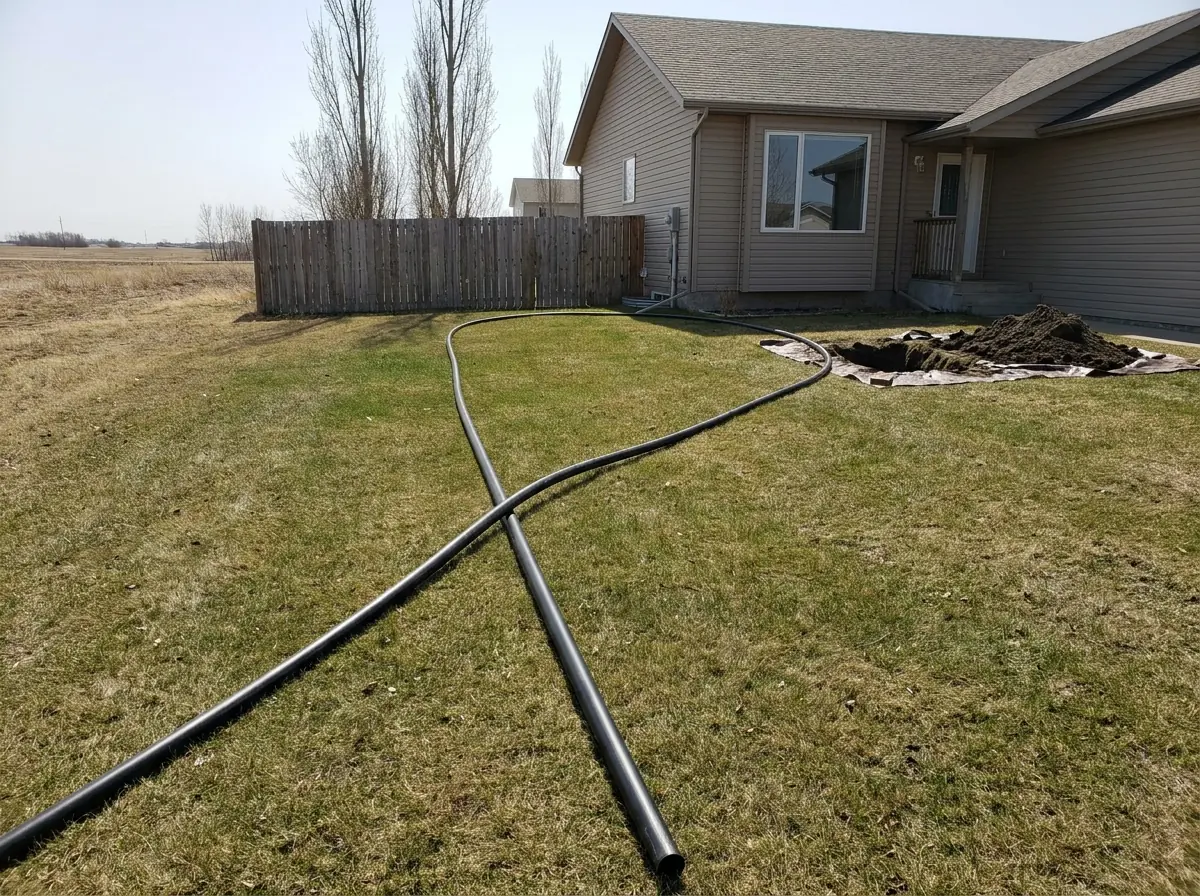
What is a trenchless sewer line?
Start with the honest answer: there is no such thing as a trenchless sewer line.
A sewer line is a pipe. Trenchless is a way of getting a pipe into the ground, or of repairing the one already there, without opening a trench along its whole length. The phrase in the search box is a method being mistaken for an object, and it is worth untangling, because the confusion is exactly what lets a contractor sell you the wrong one.
So the real question is: what do the trenchless methods do, and what do they leave you with?
What “trenchless” actually means on a residential lateral
It means two pits instead of a trench.
The pipe running from your house to the municipal connection is the sanitary lateral. Replacing it conventionally means digging along its entire length. A trenchless replacement digs at each end — commonly one pit at the house and one at the property line or the connection — and works between them from underground. The ground in the middle is never opened.
That is the entire idea. Everything else is which technique you use in the space between the two pits.
Trenchless is not excavation-free. Two pits still have to be dug. They are real holes in real ground, they need locates before anything goes in, and a page that implies otherwise is selling you something.
The three things that can happen to your pipe
1. A new pipe is pulled through the old one
This is pipe bursting. A bursting head is pulled through the existing line on a cable. It fractures the old pipe outward into the surrounding soil and drags a new fused HDPE pipe in behind it in the same pass. The old line is not removed. It becomes part of the ground the new one sits in.
What you end up with is a continuous plastic pipe with no joints anywhere between the two pits — which matters more than it sounds like it should, because on most failed clay laterals the joints were the failure.
2. A new pipe is formed inside the old one
This is CIPP lining, for cured-in-place pipe. A resin-saturated liner is pulled or inverted into the existing pipe, pressed against the host wall, and cured there. The result is a new jointless pipe formed inside the old one.
The catch is in the word host. The liner follows the pipe it is given while it cures. So the old pipe has to still be there and still be holding its shape — and whatever shape it is holding is the shape you get. Lining cannot fix a collapse, because there has to be a pipe left to line.
3. One bad section is repaired and the rest is left alone
A spot repair — a short liner over one defect rather than the whole run. It exists because most people who are told they need a new sewer line do not. A single cracked joint in an otherwise sound pipe is a small job, and treating it as a full replacement is the most common way homeowners overpay on this trade.
What you cannot do trenchlessly
Worth knowing before anyone quotes you.
- Move the line. Bursting follows the old path. Lining follows the old geometry. If the pipe is in the wrong place or at the wrong grade, it has to be dug and re-laid.
- Fix a belly. A low spot where water stands is a bedding problem, not a pipe problem. A liner will faithfully reproduce it.
- Line a water service. Lining is a sewer method. A failed water line is replaced, not relined — see water line replacement.
- Skip the branch connections. Anything joining the run partway along — a branch from a second building, a garage drain — is covered by a liner or severed by a burst, and has to be re-established afterwards as a separate operation.
How anyone decides which one you need
By looking down the pipe. A camera survey with a sonde establishes four things, and those four things decide everything else:
- What the pipe is made of. Clay, cast iron, concrete, Orangeburg, ABS, PVC. Each fails in its own way and each accepts the methods differently.
- Whether it still holds its shape. Round pipe can host a liner. Oval, collapsed or severely deformed pipe cannot.
- Where the defects are. At every joint, or at one place.
- Whether the run is even the problem. A blockage in sound plastic pipe is a cleaning, and the honest answer on the day is to say so.
Any recommendation made without that footage is a guess with a price on it. That includes ours, which is why we do not give one.
The short version
“Trenchless sewer line” means a lateral that was replaced or repaired without trenching the ground above it — most often a new jointless HDPE pipe pulled through the old line, or a cured liner formed inside it. The method is chosen from what the camera finds, not from what the homeowner asks for by name.
If you want the two full-length methods set against each other rather than described separately, that is here.
Want the line looked at?
Nothing here gets quoted off a description. The camera goes down first, you watch the screen, and you keep the footage — including on the jobs where the answer turns out to be that nothing needs replacing.