Backwater valves: what they stop, and what they do not
A backwater valve is a simple device with one job, and almost everything that goes wrong in conversations about them comes from people expecting it to do a second job it was never built for.
So, plainly: a backwater valve stops sewage coming back up your line from the municipal side. It does nothing whatsoever about a blockage on your own side.
Both of those produce water on a basement floor. Only one of them is what the valve is for.
What it is
A one-way gate installed in the drain line, usually inside the building near where the line leaves it. Normally the gate hangs open and flow passes over it in the direction it is supposed to go. When flow tries to come back the other way, the gate lifts and seals.
That is the entire mechanism. There is no power, no sensor and no controller. Which is a large part of why they are worth having: the failure modes of a flap and a seat are limited and understandable.
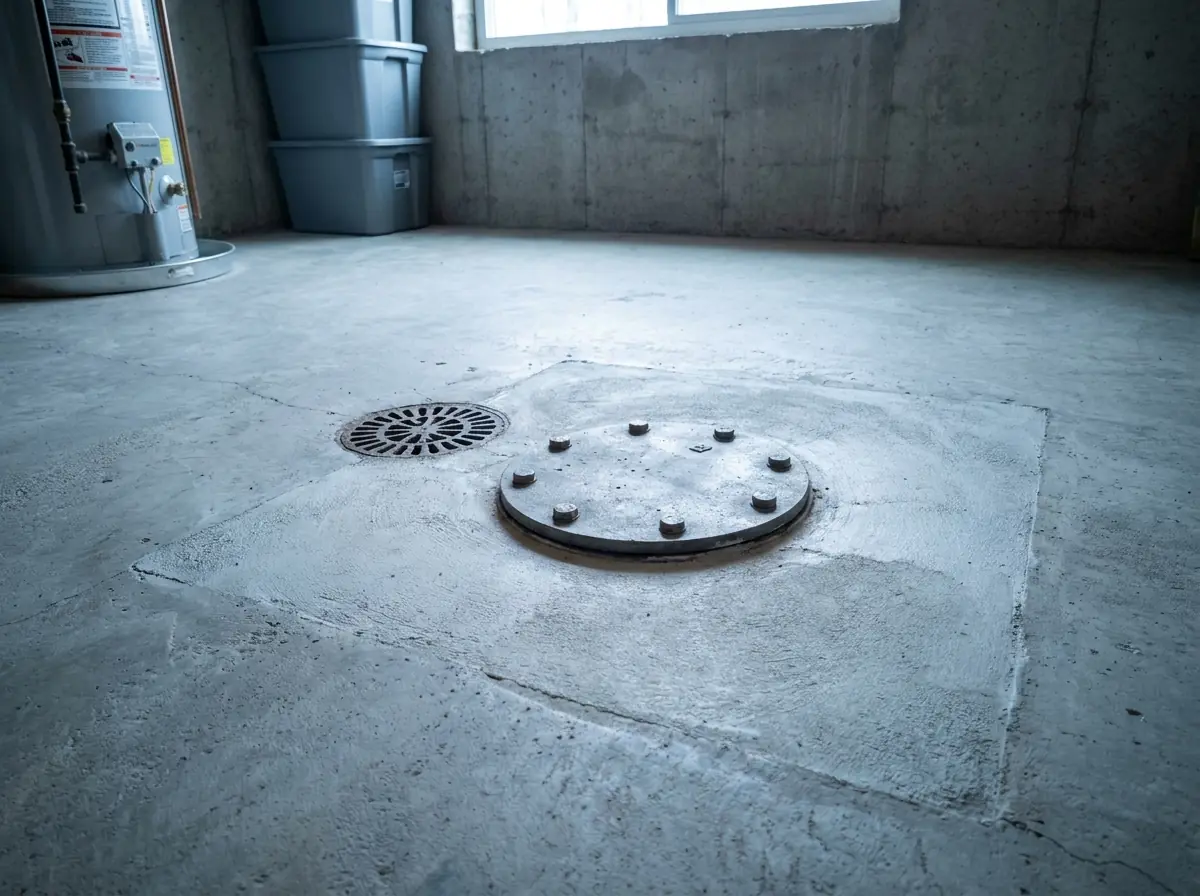
There is an access cover above it so the valve can be opened, looked at and cleaned. That cover is not optional and it is not decorative — see the maintenance section, because it is the part people regret.
The two completely different backups
This is the distinction that decides whether a valve helps you at all.
Backup from the municipal side. The sewer main surcharges — usually during heavy rain or a rapid melt, when more water is entering the system than it can carry — and the level in the main rises above the level of your basement fixtures. Water takes the easiest route, and on a house with a basement floor drain, that route is your basement.
A backwater valve is built for exactly this. The gate closes against the reverse flow and holds.
Blockage in your own lateral. A root mass at a clay joint, a collapsed section, grease, a belly holding solids. Flow cannot leave the house, backs up inside your own pipe, and comes out at the lowest fixture.
A backwater valve does nothing here. The water is on the house side of it, flowing in the direction the valve is designed to let through. The valve is doing its job correctly and your basement still floods.
In the older parts of this city, the second kind is very common, because that is where jointed clay laterals sit under mature trees. Selling a backwater valve to somebody whose actual problem is a failing lateral is selling them a device that will be sitting open while their basement fills.
So before you buy a valve, find out which one you have
A camera survey of your own line answers this, and it should come first for a straightforward reason: if your lateral has root intrusion at every joint, a valve is not the fix and it is not even the first purchase.
The sequence that makes sense is: look at the line, deal with what the line needs, then decide about the valve on its own merits. A valve installed above a line that is failing is a device guarding the one door nothing is coming through.
There is also a practical wrinkle. A valve sits in the drain, and a valve in a line that is still producing root mass and debris is a valve that is going to catch some of it. The two decisions are related.
What owning one obliges you to
More than most people are told at the point of sale. Three things.
It has to be accessible and it has to be checked. The gate and the seat are in the path of everything that leaves your house. Debris catches on the hinge, seats get fouled, and a valve that cannot close is not a valve. That access cover needs to stay reachable — not tiled over, not under a new floor, not behind a finished wall. People finish basements and bury them, and the first anyone knows about it is during a storm.
Some fixtures may want rethinking. With the valve closed, nothing can leave the building. That is the point, but it means that while the main is surcharged you should not be adding to what is sitting in your line — running a washing machine or a long shower during the event is filling a pipe that currently has nowhere to drain to.
It does not replace the rest of the drainage picture. Where water enters the property from the surface — grading toward the foundation, downspouts discharging next to the wall, a window opening below grade filling up — a backwater valve has no involvement at all. Different water, different route, different fix.
What we will not tell you on a web page
Two things, deliberately.
Whether your address requires anything, what any programme covers, and what any of it involves. Requirements, applications and any assistance that may or may not exist belong to the City of Calgary, and to Airdrie, Cochrane, Okotoks, Chestermere or High River if you are outside it. Those are the authority’s to state, they change, and being confidently wrong about a municipality’s business is worse than saying nothing. Ask them directly about your address before you commit to anything.
What your insurance does. We are not your adjuster and we are not going to speculate about your policy. If sewer backup coverage matters to you — and for anyone with a finished basement it probably should — that is a conversation with your insurer or broker, who can actually read what you hold. Do not take it from a contractor, including this one.
Who installs one
It is drain work: cutting into the line, usually at or below the basement floor, setting the valve at the right orientation, and putting a permanent access above it. Whether a permit is involved is the authority’s question, not ours, and it is worth asking before anyone opens a floor.
The part we would push hardest on is the part before it. Have the line surveyed first. A valve installed on a sound line is a sensible piece of protection against an event you cannot control. A valve installed on a failing line is a sensible piece of protection installed in the wrong place.
The short version
A backwater valve is a good device with a narrow job. It stops the system outside coming back into your house. It does not stop your own line from blocking, and in the older half of Calgary the blocked line is the more likely story.
Find out which one you have before you spend anything. That is a camera survey, and it is the same survey that would tell you whether the lateral itself needs work.
Sewer backups: why they happen · Book a camera survey · Water on the floor right now
Want the line looked at?
Nothing here gets quoted off a description. The camera goes down first, you watch the screen, and you keep the footage — including on the jobs where the answer turns out to be that nothing needs replacing.